OldStamps.org — Object File No. 007
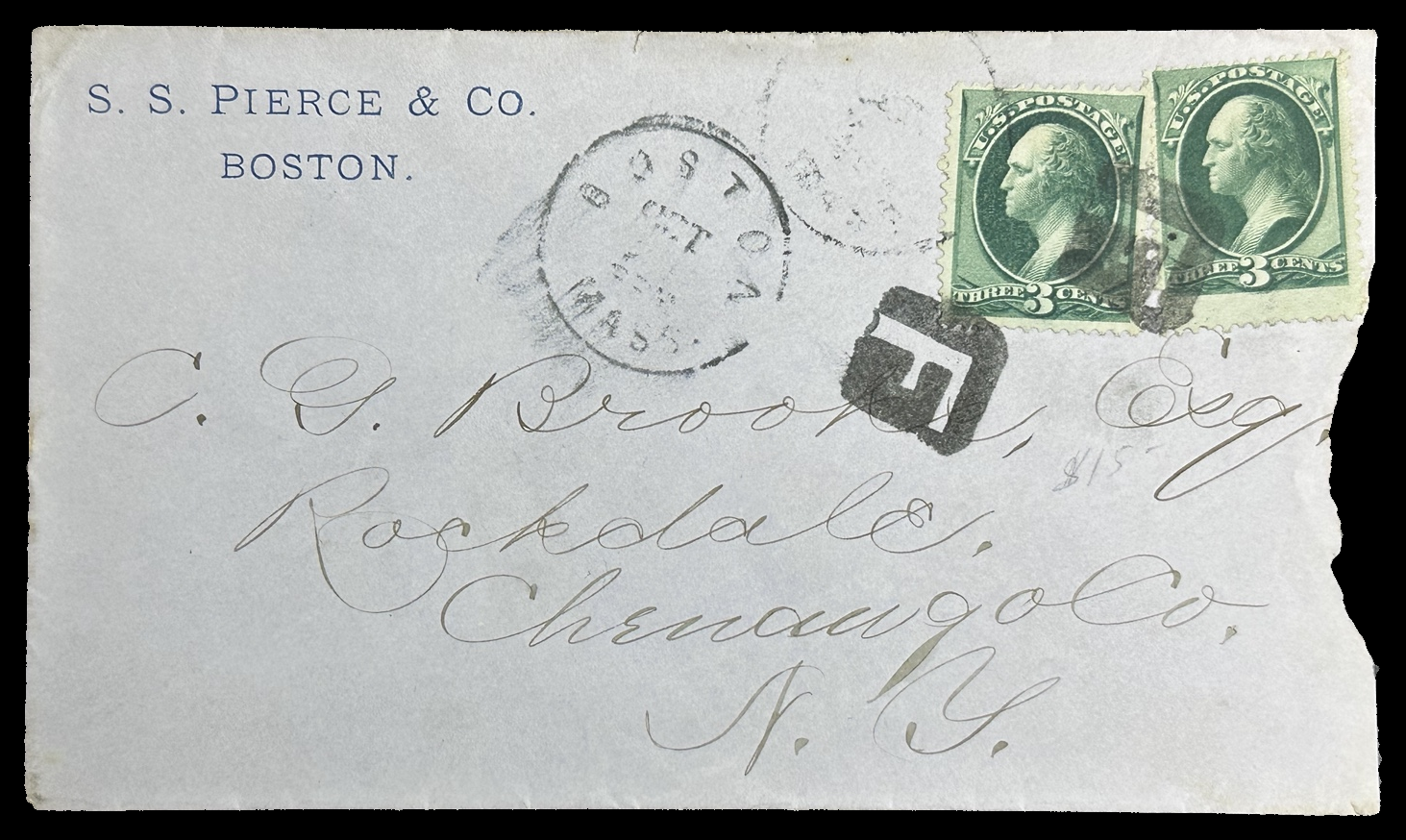
On October 7 in the mid-1870s, an envelope left Boston carrying six cents in postage and the restrained blue corner card of S. S. Pierce & Co. Its destination was not New York City, Albany, or another major commercial center, but the tiny Chenango County hamlet of Rockdale, New York. The addressee was written in an elegant hand: C. G. Brooks, Esq.
The two names on the cover open two very different nineteenth-century worlds. S. S. Pierce & Co. had grown from a small Boston grocery established in 1831 into one of the city’s best-known importers and purveyors of specialty foods. Charles Greenwood Brooks, the man at Rockdale, was a twenty-something member of a Massachusetts family that had migrated into rural New York; he would later become a successful manufacturer and dealer in lumber, timber, and railroad ties. Between them lies a six-cent letter whose contents have disappeared, but whose postage, cancel, address, and commercial origin still allow much of its setting to be reconstructed.
A Boston house established in 1831
Samuel Stillman Pierce was born in Dorchester, Massachusetts, on March 27, 1807. Before establishing his own concern, he worked for a Boston importing house—an early experience that helps explain the international character his grocery business would eventually assume. In 1831 Pierce entered partnership with Eldad Worcester under the name Worcester & Pierce.
Their shop stood at the corner of Tremont and Court Streets. A later Suffolk County history, drawing on the firm’s early records, dates the partnership to October 21, 1831 and identifies the first recorded sale on that date. Worcester eventually retired. On April 1, 1844, longtime clerk Charles L. Eaton entered the partnership and the firm became S. S. Pierce & Co.; Pierce’s son Wallace joined the following year.
The same nineteenth-century history describes the business growing from extremely modest beginnings into a major Boston mercantile house. Its account books survived when those of many contemporary firms did not, preserving the names of customers and the changing scale of the operation. Later recollections emphasized a progression from wheelbarrow and handcart deliveries to horse-drawn wagons as the clientele expanded.
Importers as well as grocers
The word “Importers”, so often associated with S. S. Pierce advertising, was not an ornamental title. The company developed a reputation for foreign foods, wines, spirits, cigars, teas, fruits, and other specialty goods that were still unusual in much of the American market.
Historic New England preserves surviving S. S. Pierce trade material documenting this identity. An 1883 price list describes imported and domestic canned goods, wines, liquors, cigars, and holiday specialties, including products sourced from Wiesbaden, Germany. The catalog also notes that the business had occupied Tremont and Court Streets since October 1831. By then demolition and rebuilding had temporarily displaced the firm, but during the probable 1870s date of this cover the old downtown location remained the company’s center.
The firm’s longevity at one corner became part of its reputation. It catered to Boston households that wanted products beyond ordinary staples, while its position in a major Atlantic port connected it to the wider world of shipping and imported provisions. By the time Samuel Stillman Pierce died in 1880, the name had already become a recognizable Boston institution.
The address: C. G. Brooks, Esq.
The recipient can now be read securely from the original cover:
C. G. Brooks, Esq.
Rockdale
Chenango Co.
N.Y.
That transcription points with high confidence to Charles Greenwood Brooks. Francis Everett Blake’s 1915 genealogy of Princeton, Massachusetts, records the family of Moses and Sophronia Greenwood Brooks. It states that they moved from Princeton to Oxford, New York, in 1856 and then to Rockdale in 1862. Their youngest listed son was Charles Greenwood Brooks, born December 23, 1849, whose residence is explicitly given as Rockdale, New York.
The match is unusually strong: initials, surname, exact small-town residence, and age all fit the surviving envelope. At the probable date of mailing, Brooks would have been about twenty-five to twenty-seven years old.
From Rockdale to the timber business
A later biographical compendium adds the adult career that the Princeton genealogy does not. It identifies Charles Greenwood Brooks as a businessman and manufacturer educated at New Berlin Academy and Norwich Academy. For many years, it says, he was a successful manufacturer and dealer in lumber, railroad ties, and timber at Mount Upton, only a few miles north of Rockdale.
Brooks later entered public life as well. He served as supervisor of the Town of Guilford in 1902–03 and held other local positions of trust. Cemetery records at Mount Upton record Charles G. Brooks, 1849–1921, providing a final geographic link to the same family and community.
None of those later facts proves that Brooks was already in the lumber business when S. S. Pierce wrote to him. The cover likely dates from the 1870s, when he was still a young man. The title “Esq.” should likewise not be taken as proof that he practiced law; no evidence located in this research identifies him as an attorney. In nineteenth-century correspondence, “Esquire” could function simply as a courtesy title for a respectable adult man.
Rockdale on the Unadilla
Rockdale was small enough that the address required no street or house number. Period histories place the hamlet on the west bank of the Unadilla River in the Town of Guilford. A county history describes it as lying about four miles below Mount Upton on the New Berlin branch of the Midland Railroad, which opened for business in 1871.
By around 1880 Rockdale had only about eighty inhabitants, but it was not economically isolated. The hamlet contained a church, district school, hotel, saw and grist mill, store, creamery, carriage and blacksmith shop, and shoe shops. The railroad linked this small rural settlement to the same regional and national commercial system through which Boston firms could solicit orders, extend credit, ship goods, and conduct correspondence.
That transportation connection is important to understanding the envelope. S. S. Pierce’s business depended not merely on customers who could walk into a Boston store, but on the increasingly dense nineteenth-century networks of rail, express, and mail that made distant trade practical. A letter to Rockdale was therefore not correspondence to an inaccessible backwater; it was part of an expanding national market.
October 7—and a Boston negative “F”
The Boston circular datestamp on the cover clearly reads OCT 7, but the year is not visible. The cancellation on and beside the stamps provides the more useful dating evidence.
The bold killer is a negative letter “F”: the letter appears uninked within a dark field. Specialist studies of Boston cancellations identify a family of small negative-letter killers, generally 15–20 millimeters in diameter or width, using letters A through H. The Massachusetts Postal Research Society reports that these small negatives first appeared in 1875 and that the last known use occurred on May 4, 1878, immediately before Boston introduced its better-known large negative killers.
The U.S. Cancellation Club has discussed the small negative “F” specifically, identifying it as a hand-carved variation within this early Boston group. The specialist literature is somewhat cautious about the very earliest year of the series, but evidence places the small “F” in use by at least 1876–77.
Because our cover is dated October 7, it cannot belong to 1878 if the reported May 1878 end date is correct. The strongest working date is therefore October 7, probably 1876 or 1877. A conservative catalog description could broaden that slightly to circa 1875–77.
Why six cents?
The envelope carries two green 3-cent Washington stamps for a total of six cents. During this period the ordinary first-class domestic letter rate was three cents per half ounce. Six cents therefore corresponds naturally to a double-weight domestic letter—more than one-half ounce and no more than one ounce.
The National Postal Museum describes the 3-cent Washington as the workhorse stamp of the era. National Bank Note Company had issued the design beginning in 1870, and Continental Bank Note Company reused the same basic plates after receiving the federal stamp contract in 1873. Continental added small “secret marks” to distinguish most of its printings; on the 3-cent Washington that distinction lies in the ribbon below the word “THREE.”
The photograph is not sufficient to make that microscopic distinction securely. If the cover dates to 1876–77, the stamps could be the Continental printing commonly cataloged as Scott 158, but an earlier National Bank Note printing remained valid and cannot be ruled out from the image alone. The correct course is to identify them as green 3-cent Bank Note Washington issues unless physical examination establishes the printing.
What was inside the envelope?
The six-cent postage is one of the most suggestive clues on the object because it indicates that this was probably not the lightest possible one-sheet letter. A double-weight envelope could have contained several sheets of correspondence, an invoice and statement, order material, a small price list, or other business papers folded into first-class mail.
But the contents are gone, and no surviving source discovered in this research identifies the transaction. We do not know whether Brooks was buying imported groceries, settling an account, requesting a catalog, acting for someone else, or corresponding with the firm for an entirely different reason.
His later lumber career is historically interesting but should not be used to invent a commercial relationship. There is no evidence that Brooks supplied lumber to S. S. Pierce, or that the Boston firm had any timber transaction with him. What survives is simpler: a prominent Boston importer mailed a heavier-than-single-rate letter to a young man in rural Chenango County who can now be identified by name and biography.
The red S. S. Pierce company seal
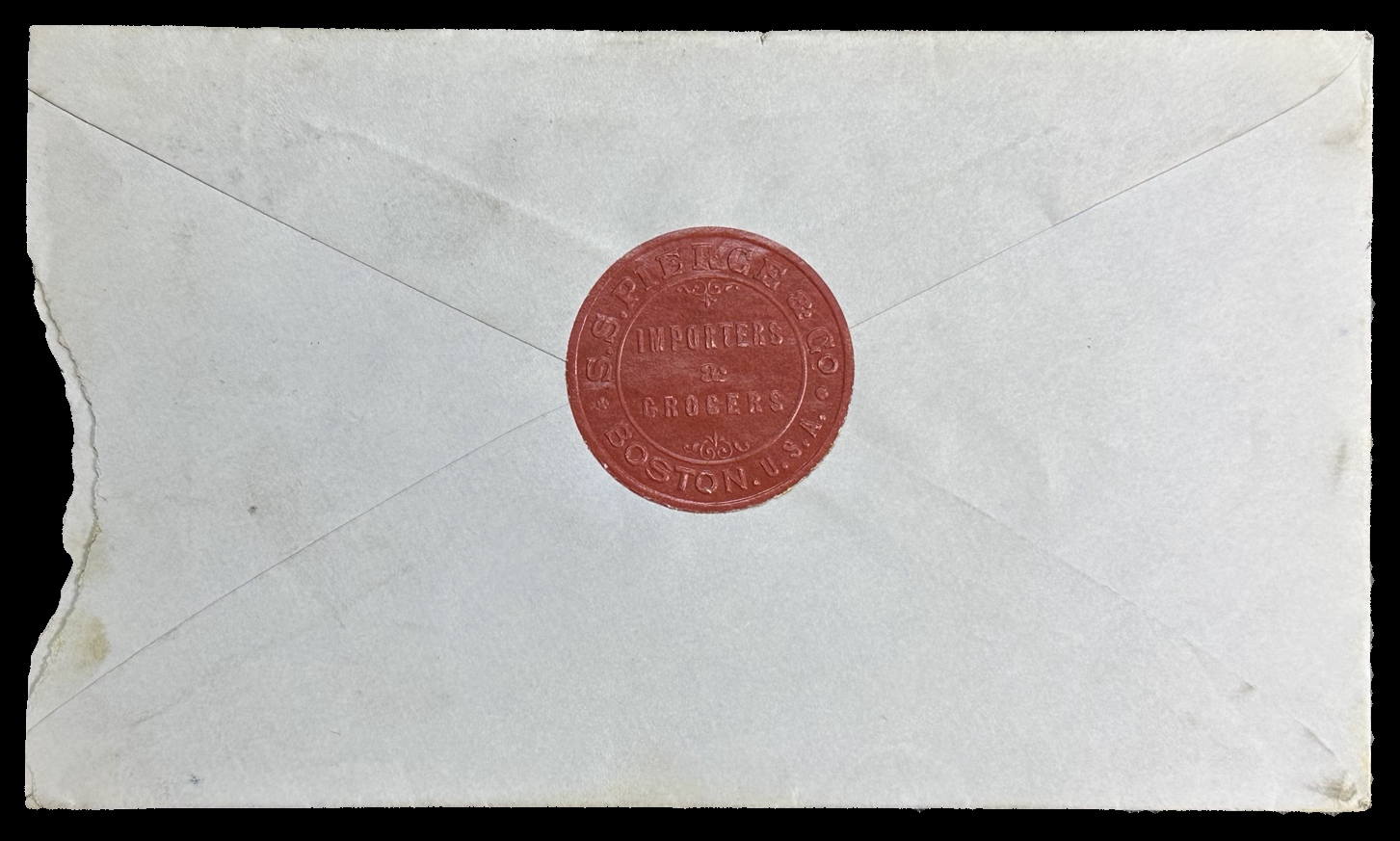
The reverse adds another unusually attractive feature: a large red embossed company seal centered on the back flap. Its inscription reads “S. S. Pierce & Co. — Importers & Grocers — Boston, U.S.A.” The seal is not merely decorative. It reinforces the firm’s identity as both an importing house and grocery concern and gives the envelope a distinctly branded commercial character that would have been immediately recognizable when the letter arrived.
For collectors, the seal substantially increases the cover’s visual and historical appeal. Unlike the printed corner card on the front, which identifies the sender in restrained blue type, the embossed red seal turns the reverse into a second advertising surface. Together, the corner card, six-cent franking, Boston cancellation, handwritten address, and intact company seal make the envelope a particularly complete example of nineteenth-century commercial postal history.
From a Boston counter to a national market
The history preserved by this envelope is larger than either the grocery firm or its recipient. In 1831 Samuel Stillman Pierce began at a Boston corner where imported goods entered an expanding urban consumer culture. By the 1870s, S. S. Pierce & Co. could write to customers and contacts far beyond the city, relying on a postal system whose predictable weight-based rates and increasingly standardized cancellations handled enormous volumes of commercial correspondence.
At the other end of the route was Rockdale: eighty people, a river, mills, a creamery, workshops, and a railroad connection opened only a few years before this likely mailing. Charles Greenwood Brooks belonged to a family that had moved there from Massachusetts, and he would build his own career in lumber and timber a few miles up the valley.
The letter itself is lost. Yet the cover still reconstructs the network around it: Boston importing, rural New York enterprise, the Midland Railroad, a six-cent double-weight rate, and one of the distinctive small negative-letter cancellations used by the Boston post office in the 1870s. The object survives because all of those systems briefly met on one envelope.
Object file
- Object: S. S. Pierce & Co. commercial cover.
- Origin: Boston, Massachusetts.
- Sender: S. S. Pierce & Co., established Boston grocers and importers.
- Destination: Rockdale, Chenango County, New York.
- Addressee: C. G. Brooks, Esq.; identified with high confidence as Charles Greenwood Brooks (1849–1921).
- Postmark: Boston, Massachusetts circular datestamp, October 7; year absent or illegible.
- Cancellation: Small Boston negative-letter “F” killer, consistent with the early Boston negative series used in the mid-1870s.
- Probable date: October 7, probably 1876 or 1877; conservatively circa 1875–77.
- Franking: Two green 3-cent Washington Bank Note stamps, six cents total.
- Likely rate: Double-weight domestic first-class letter, over one-half ounce and up to one ounce.
- Stamp identification: Exact National vs. Continental Bank Note printing unresolved from the photograph; Continental Scott 158 is plausible but not assigned without physical examination.
- Recipient context: Brooks family resident at Rockdale from 1862; Charles later became a manufacturer and dealer in lumber, railroad ties, and timber at nearby Mount Upton and served as Guilford town supervisor.
- Reverse: Envelope reverse with a prominent red embossed S. S. Pierce & Co. company seal reading “Importers & Grocers — Boston, U.S.A.,” along with flap/opening wear and age toning; no receiving backstamp visible.
- Research caution: The original contents and purpose of the S. S. Pierce correspondence are unknown. Brooks’s later lumber career is documented but is not evidence of the reason for this letter.
- Collecting interests: Boston postal history; S. S. Pierce & Co.; commercial covers; grocery and food history; Bank Note issues; fancy cancellations; Boston negative killers; Chenango County; Rockdale; business history.
Research notes and sources
The cover itself establishes the sender, addressee transcription, October 7 Boston postmark, six-cent franking, and negative-F cancellation. The dating is an inference from specialist cancellation literature rather than a visible year date. Recipient identification rests on the unusual combination of initials, full surname, exact Rockdale residence, and contemporary family history. No attempt has been made to reconstruct the missing contents beyond what the postal rate reasonably indicates.
- Professional and Industrial History of Suffolk County, Massachusetts, Vol. II — biographical and business history of Samuel Stillman Pierce; Worcester & Pierce in 1831; change to S. S. Pierce & Co. in 1844; early ledgers and growth of the firm.
- Dorchester Historical Society, Samuel Stillman Pierce — Pierce’s Dorchester background, early work for a Boston importing firm, and the firm’s reputation for specialty foods.
- Historic New England, S. S. Pierce & Co. 1883 price list — imported and domestic foods, wines, liquors, cigars, and the firm’s statement that it had occupied Tremont and Court Streets since October 1831.
- Historic New England, food-enterprise ephemera — surviving S. S. Pierce trade card identifying the Hemenway Building at Court and Tremont Streets.
- Francis Everett Blake, History of the Town of Princeton, Massachusetts, Vol. II (1915) — Moses and Sophronia Brooks family migration to Rockdale in 1862; Charles Greenwood Brooks, born December 23, 1849, resident Rockdale.
- Origin and History of the Name of Brooks (1905) — Charles Greenwood Brooks’s education, lumber/timber/railroad-tie business at Mount Upton, and later public service.
- History of Chenango County, Rockdale and Mount Upton — Rockdale’s population, businesses, mills, post-office history, and location on the New Berlin branch of the Midland Railroad, opened in 1871.
- The Massachusetts Spy, Summer 2011, “Brief Notes on the Boston Negatives” — specialist chronology of the small Boston negative-letter killers: first appearance in 1875 and last reported use May 4, 1878.
- U.S. Cancellation Club NEWS, May 2010, “More on Small Boston Negatives” — discussion and illustration of the small negative “F” and evidence for its use before the large Boston negatives.
- Smithsonian National Postal Museum, Continental Bank Note Large Bank Note Issues (1873) — three-cent domestic letter rate and the secret-mark distinction on the 3-cent Washington.
- Smithsonian National Postal Museum, National Bank Note Large Bank Note Issues (1870–71) — earlier 3-cent Washington design and six-cent double-weight domestic-rate context.
- Smithsonian National Postal Museum, U.S. Domestic Letter Rates — domestic first-class rate chronology.


Leave a Reply