OldStamps.org — Object File No. 002
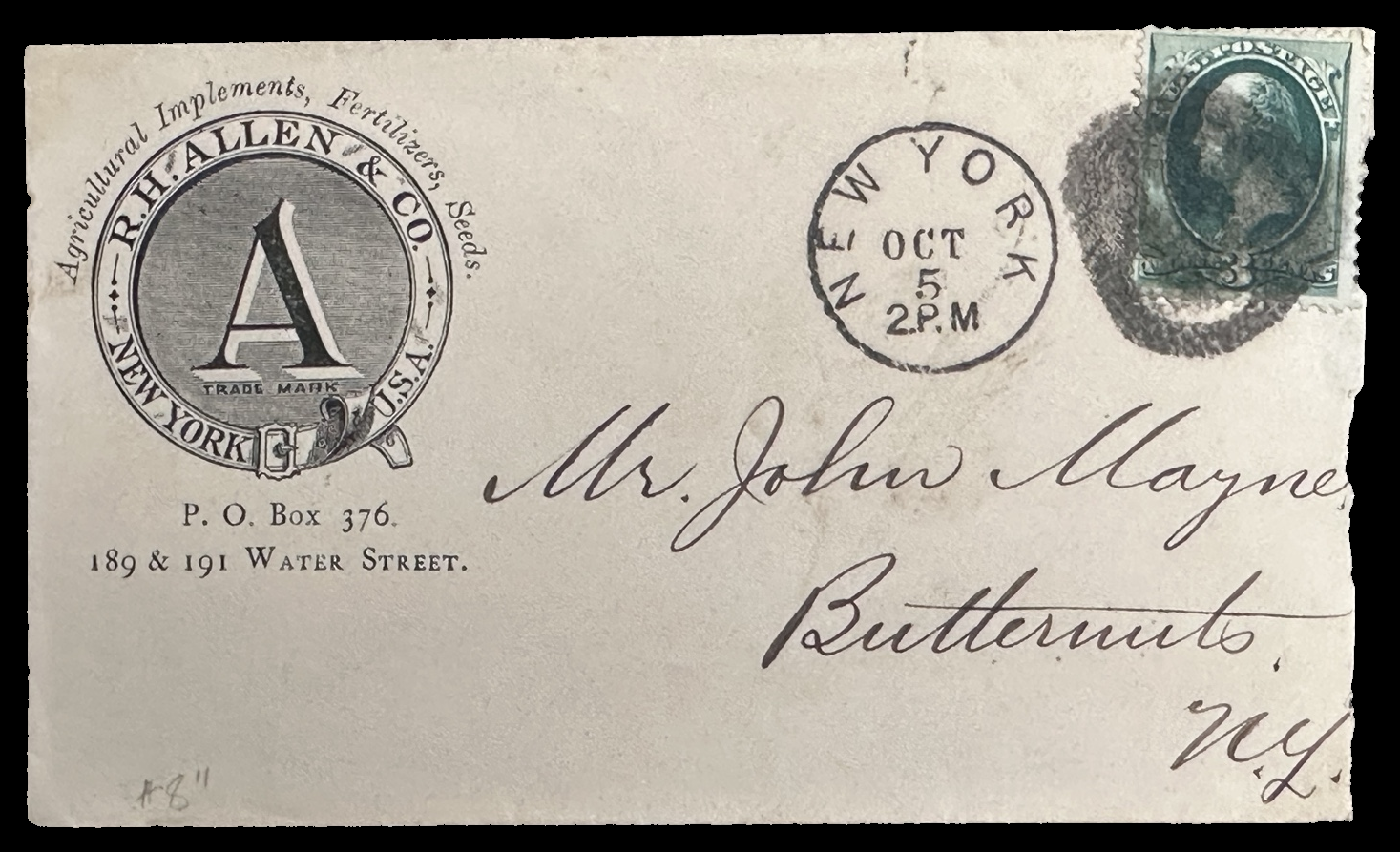
In October of the 1870s, a New York agricultural supply house sent a letter to a man in the Butternut Valley of upstate New York. Its envelope did two jobs at once. A three-cent Washington stamp paid for delivery, while a bold circular device advertised the sender’s machinery, fertilizers, and seeds. The recipient, John Mayne, was more than an anonymous rural customer: contemporary business directories identify a foundry operator of that name at precisely the address written on the cover. The letter itself is gone. The envelope, and a surprising number of records surrounding it, survive.
FROM THE TNSTAMPS COLLECTION · ORIGINAL COVER ON EBAY
Explore or purchase this original cover
The R. H. Allen & Co. agricultural advertising cover examined in this article has its own eBay listing. Follow the link to see the original item, photographs, price, and current availability.
Offered through the affiliated TNstamps collection. You can also browse more postal history from TNstamps. This historical article will remain available after the cover sells.
A circular trademark made to be noticed
The left side of the envelope is occupied by a large circular printed emblem. Around its upper edge runs the firm’s statement of business: “Agricultural Implements, Fertilizers, Seeds.” The inner ring names R. H. Allen & Co., surrounds an oversized letter A, and carries the words “TRADE MARK.” Below are two useful pieces of information: P. O. Box 376 and 189 & 191 Water Street. The design is handsome, but it is practical advertising too: the identity and address of the sender would remain before the recipient long after the letter was opened.
The printed word “Trade Mark” is a claim made on the stationery, not, by itself, evidence that the device was federally registered. Its great decorative A, the ringed lettering, and the prominent trade categories belong to an era when merchants used envelopes, catalogues, invoices, and letterheads as mutually reinforcing advertising space. Nothing on this envelope identifies a specific manufacturer of plows, harvesters, or other implements; the firm advertised itself as a supplier, and that distinction matters.
The business at 189 and 191 Water Street
Allen’s address is not an isolated piece of evidence. Trow’s New York City Directory for 1870 lists “ALLEN R H Co” among agricultural-implement businesses at 189 Water Street. More revealing still, the company’s own 1870 retail-priced seed catalogue gives the combined address 189 and 191 Water Street, calling the premises agricultural implement and seed warehouses. The cover and these independent records agree on both the address and the character of the trade.
The company had been in this line of business for years. The Smithsonian Institution’s Warshaw Collection of Business Americana records R. H. Allen & Co. seed catalogues dated 1866 and 1870. New York University’s archival finding aid likewise identifies a copy of the 1870 catalogue in its Horticultural Society of New York materials. And an 1881 descriptive catalogue, preserved in the USDA National Agricultural Library’s seed-trade collections, shows the company was still publishing material under the same name several years after this letter’s apparent date. These sources establish a documented span of activity; they do not, on their own, settle the founder’s full name or the firm’s ultimate fate.
What Allen’s own catalogue tells us
A period catalogue offers something an advertising envelope cannot: a look inside the seller’s working practices. The 1870 booklet offered vegetable, flower, fruit, herb, and field seeds, with descriptions, cultivation advice, and individual prices. It was not just a bare price list. The firm discussed varieties of asparagus, beans, beets, cabbages, and many other plants; it promoted such named varieties as Conover’s Colossal asparagus and Rising Sun tomato. The volume presents a commercial world in which a seller was also expected to advise buyers about soil, sowing, spacing, and crop selection.
In its opening instructions, Allen & Co. urged correspondents to send orders before the pressure of spring business and to supply a complete postal address, including post office, county, and state. Most tellingly for this cover, it asked customers to write implement orders on a separate sheet from seed orders. That brief instruction demonstrates that both branches of the business were active enough to need distinct handling. The catalogue also published charges for mailing small seed packages around the United States; the mail was not only a channel for sales correspondence but also a means of distributing some of the merchandise itself.
The catalogue claimed that nearly all its American seeds were raised under close supervision and that varieties unsuitable for domestic production were selected through trusted European contacts. Those are the firm’s own marketing assertions, not independently verified statements of quality. They nevertheless reveal the image Allen wanted to project: reliable stock, wide choice, specialist knowledge, and service to distant buyers. The envelope was part of that same commercial system. The contents of this particular letter are unknown, but the printed heading makes clear why an agricultural or mechanical tradesman might have been on the mailing list.
John Mayne: a name found in the historical record
The address is written in flowing script to “Mr. John Mayne, Butternuts, N.Y.” That name can be checked against an unusually helpful contemporary source. The Gazetteer and Business Directory of Otsego County, New York, for 1872–73 explicitly lists “Mayne, John, (Butternuts,) foundry.” Another entry records “Mayne, J.” in a sawmill partnership with J. R. Blackman and J. Turner. The shared surname, initial, and post-office address strongly suggest a connection, but the directory does not expressly state that the sawmill partner and the foundry operator are the same man.
Independent confirmation comes from the History of Otsego County, published in 1878. In its description of Gilbertsville’s current business interests, it includes a foundry operated by “J. Mayne.” The match between the cover, the 1872–73 directory, and the later county history makes the identification of the addressee as a local foundryman persuasive. It does not establish what he bought, whether he placed an order, or whether this letter concerned machinery at all.
A foundry was a significant business in a rural manufacturing district. Cast-metal parts served agricultural machinery, mills, carts, workshops, and the equipment needed to keep farms and small industries working. That background makes a letter from a New York agricultural-implement warehouse to a foundry operator entirely plausible as business correspondence. Plausibility, however, is not proof: without the enclosure, a purchase order, an invoice, or an account ledger, the actual reason for the communication remains open.
Butternuts, Gilbertsville, and a changing postal name
The destination was not a distant, unmapped place. Butternuts was an Otsego County town in central New York, and Gilbertsville was its principal village. Yet the address on this envelope presents a small puzzle for postal historians. A New York post-office master index records that a post office called Gilbertsville took the name Butternuts on March 26, 1851, and returned to Gilbertsville on June 22, 1874. If the reverse annotation correctly dates this cover to October 1875, the handwritten destination still uses the earlier office name.
There is an important qualification: a later Methodist historical account says that the Gilbertsville name was restored in 1877, not 1874. The references therefore disagree on the precise timing. In addition, the town itself continued to be called Butternuts. This is best treated as evidence of nineteenth-century local naming habits—and a question worth checking against original Post Office Department records—rather than proof that the letter was improperly addressed or misrouted. No receiving cancellation is visible to demonstrate the path taken after it left New York.
The county history supplies a more tangible glimpse of life there. It describes Gilbertsville on the west side of Butternut Creek and recounts two serious fires, the second in 1874, which destroyed more than thirty buildings. Its later inventory of shops and trades, including Mayne’s foundry, shows a community of merchants, craftspeople, mills, and local services. We cannot infer that this particular letter concerned rebuilding after the fire. It does, however, belong to the period in which the village was recovering and continuing its commercial life.
The October 5 postmark, the negative “8” fancy cancel, and the three-cent Washington
The postal evidence is plain at the center and right of the front. A circular New York datestamp reads “NEW YORK / OCT / 5 / 2 P.M.” The year is not present in the visible circular marking. The black mark striking the green three-cent Washington adhesive is not simply an anonymous obliterator: it is recognizable as a fancy negative “8” numeral cancel, whose uninked character appears against a dark inked field. Depending on orientation and how fully the device struck the stamp, it can also resemble a negative letter “G.” The stamp has the appearance of a nineteenth-century Washington Bank Note issue, but its precise printing, shade, and Scott catalogue number should not be assigned from this photograph alone.
This identification matters because New York’s numbered killers were part of a documented postal practice. In “Cancelers With Numbers in NYC Handstamps—First Class Mail”, published in the Cancellation Club News (1996), Roger D. Curran reports that the main New York post office began using numbered hand-carved killers on out-of-town domestic mail in 1872. Negative Arabic numerals—light figures cut into otherwise inked designs—were the most common form, and such hand-carved numbers remained in use until 1876. The same journal illustrates another negative “8” dated October 27, 1875, corroborating the design’s use during the month indicated by this envelope. That comparison does not, by itself, prove the two marks came from the same individual handstamp.
The distinction between “8” and “G” deserves care. The “G” is a reasonable visual reading of this particular strike, but the documented New York sequence supports a numbered killer rather than a separately established letter “G” device. Curran emphasizes how carving, orientation, ink, and wear complicate interpretation. A New York Post Office report from 1877, quoted in his study, explains that numbered handstamps helped associate markings with stamping clerks and certain street-box collections; it does not identify which clerk handled this 1875 letter. A modern auction catalogue uses Cole NYC-19 for a negative “8” on another Bank Note stamp, but assigning that exact specialist type to the Allen cover would require a direct design comparison. The safe description here is New York fancy negative “8” cancel (G-like impression).
The three-cent denomination is consistent with the ordinary domestic letter rate in force at the time. According to the United States Postal Service’s historical rate table, a letter weighing up to one-half ounce ordinarily required three cents from July 1, 1863, until October 1, 1883, when the rate fell to two cents. There is no visible indication here of special service, registration, or an unusual rate. The cover’s postal interest rests in its fancy numbered obliterator as well as its commercial origin, advertising design, destination, and identifiable addressee.
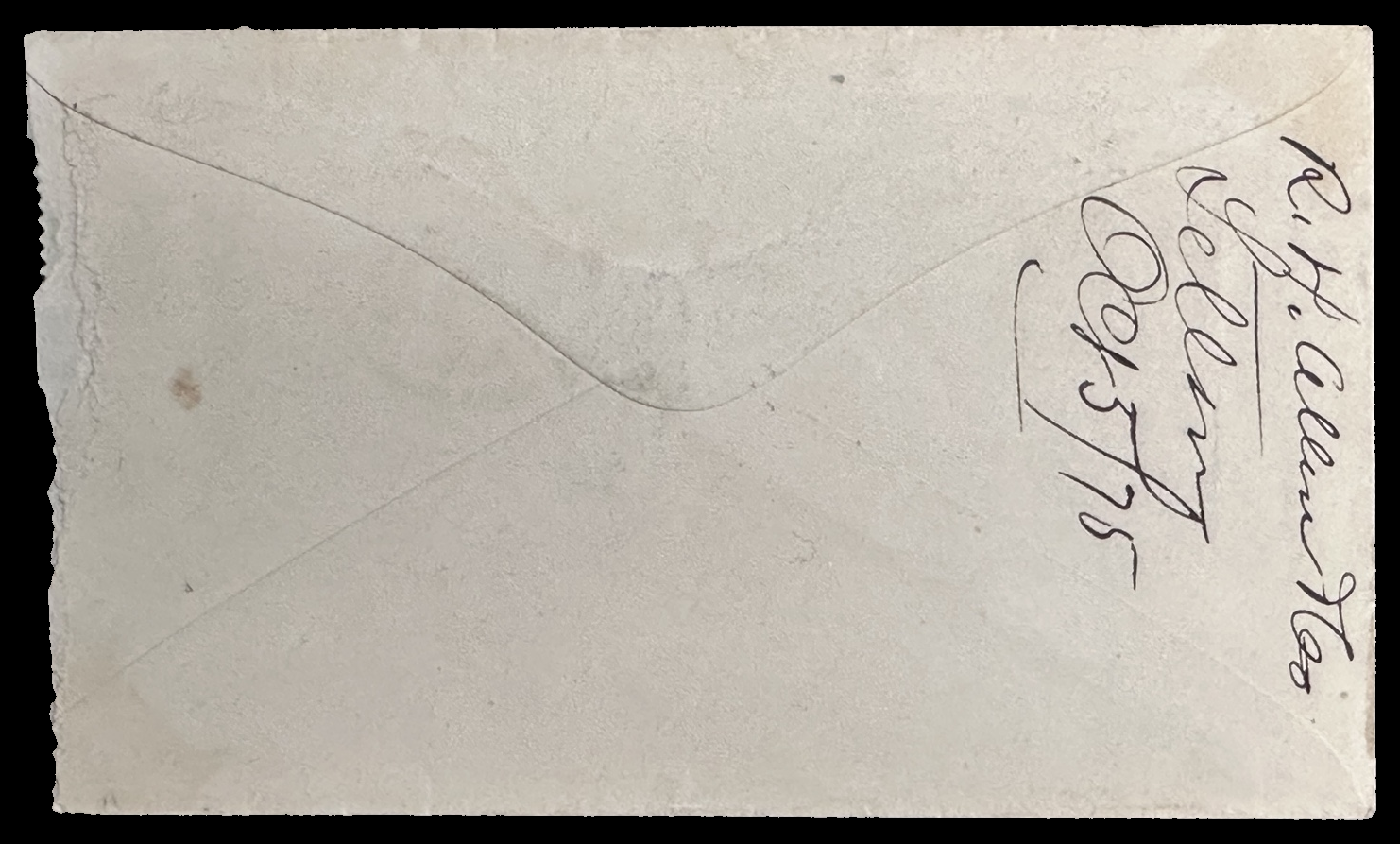
On the reverse is a large contemporary-looking manuscript notation naming R. H. Allen & Co. and appearing to end with “Oct 5/75.” This is the principal evidence for the year 1875. It fits the style of the stamp and the firm’s documented period of operation, but is separate from the postal cancellation and cannot be treated as a year struck by the post office. A rigorous listing would describe the envelope as apparently October 5, 1875, with the date supported by the reverse annotation.
The envelope as an object
This is a used advertising envelope, not an unused trade card and not a folded letter with its message still inside. Its surviving front and reverse show handling wear, toning and some discoloration, a rough or opened edge, and manuscript marks beyond the address. These are part of the object’s actual condition and should be visible in any sale photographs. The circular emblem remains especially legible. Both sides matter: the front carries the illustrated advertising and postal evidence, while the reverse provides the most direct clue to its year.
It is tempting to turn such a cover into a complete story of a transaction. A New York warehouse sold agricultural supplies; a named foundryman lived in a village dependent on farms and local industry; an envelope moved between the two. The archive supports each of those statements individually, but not the missing business deal that might connect them. What survives is a network rather than a narrative with a final invoice: urban supplier, rural craftsperson, nineteenth-century postal service, and the printed identity of a company that expected its customers to recognize a great letter A.
Object file
- Object: Illustrated commercial advertising cover for R. H. Allen & Co.; used envelope, front and reverse preserved.
- Origin: New York, New York; circular datestamp October 5, 2 P.M. (year absent from the cancel).
- Attributed year: 1875, from a reverse manuscript notation that appears to read “Oct 5/75”; attribution rather than postal-year certainty.
- Sender / printed return details: R. H. Allen & Co.; agricultural implements, fertilizers, seeds; P. O. Box 376; 189 & 191 Water Street, New York.
- Addressee: Mr. John Mayne, Butternuts, New York; contemporary directories identify John Mayne as a foundry operator.
- Postage: Green U.S. three-cent Washington Bank Note-type adhesive; exact Scott number and printing not confirmed.
- Markings: New York October 5 circular datestamp and fancy negative “8” numeral obliterator (an impression that can resemble a negative “G”); no clear receiving backstamp visible. Specific Cole subtype not established.
- Condition: Period handling wear, toning, some staining, and opened/rough edge; see both photographs.
- Collecting interests: U.S. postal history; fancy numeral cancellations; nineteenth-century New York City obliterators; illustrated advertising covers; agricultural implements and seed trade; New York City commercial history; Otsego County / Gilbertsville / Butternuts.
Research notes and sources
The interpretation above distinguishes observations from the original cover, claims printed by the business itself, and facts verified in contemporary records. The central identification of John Mayne rests on two independent nineteenth-century sources. The exact contents of the letter, the precise year as struck by a post office, the stamp’s Scott number, the exact fancy-cancel die classification, and the official date of the Butternuts–Gilbertsville postal-name change remain qualified.
- Allen’s Seed Catalogue (1870) — the firm’s own 40-page illustrated retail-price catalogue; title page, 189–191 Water Street address, products, instructions for orders, and mailing seeds.
- Smithsonian National Museum of American History, Warshaw Collection: Seed Industry and Trade — archival description recording R. H. Allen & Co. catalogues in 1866 and 1870.
- New York University Special Collections, Horticultural Society of New York records — finding aid for a surviving R. H. Allen & Co. catalogue dated 1870.
- Trow’s New York City Directory (1870) — commercial listing of R. H. Allen & Co. as agricultural-implement merchants at 189 Water Street.
- Biodiversity Heritage Library, Descriptive Catalogue of Choice Farm, Garden and Flower Seeds, Roots, Plants and Garden Requisites (1881) — bibliographic evidence of a later company catalogue.
- Gazetteer and Business Directory of Otsego County, New York, for 1872–73 — John Mayne listed with a foundry; a J. Mayne listed in a sawmill partnership.
- History of Otsego County, New York (1878) — Gilbertsville businesses, J. Mayne’s foundry, and the 1874 fire.
- New York State Post Offices Master Index — Butternuts / Gilbertsville changes, with 1874 restoration date; compare the later Methodist history, which says 1877.
- United States Postal Service, Rates for Domestic Letters Since 1863 — the standard three-cent letter-rate period.
- Roger D. Curran, “Cancelers With Numbers in NYC Handstamps—First Class Mail,” Cancellation Club News, vol. 23, no. 6 (Fall 1996) — documents New York’s 1872–76 hand-carved numbered killers and reproduces contemporary post-office reporting; the issue also illustrates an October 27, 1875 negative “8.”
- Golden Oak Auctions, Sale 85 (December 2025), lot 58 — a comparison negative “8” on an 1873 Bank Note issue catalogued as Cole NYC-19; not a confirmed subtype attribution for the Allen cover.
The original envelope is part of the TNstamps collection. View the exact cover on eBay. Historical interpretation and the commercial availability of the object are separate; this research remains online after the item sells.


Leave a Reply