OldStamps.org — Object File No. 003
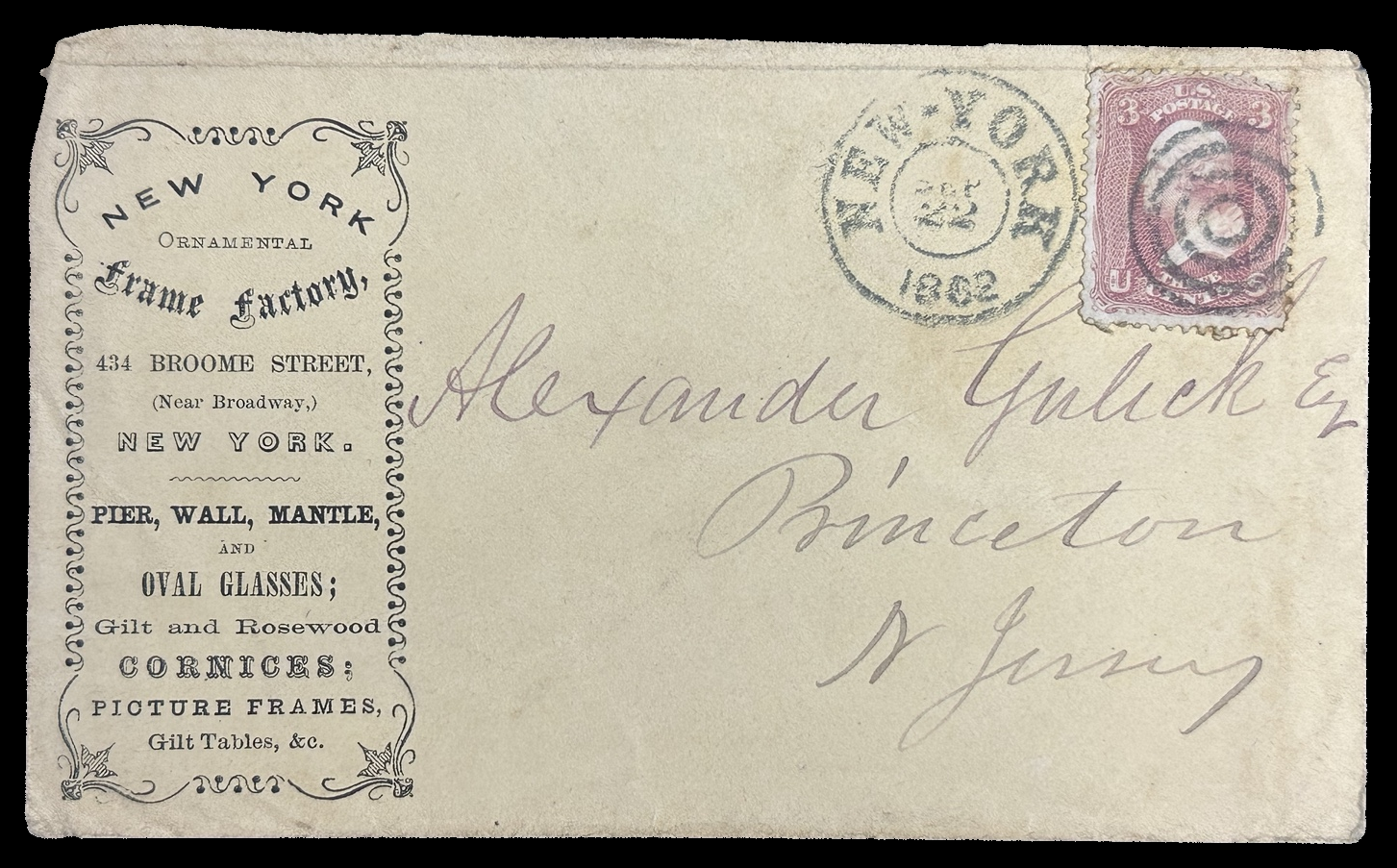
In 1862, an elaborately printed commercial envelope left New York City for Princeton, New Jersey. A three-cent Washington stamp carried it across a relatively short distance, but the envelope itself advertised a much larger world: looking glasses, ornamental frames, gilt furnishings, cornices, and the decorative trade that helped shape prosperous American interiors on the eve of and during the Civil War. Its destination adds another layer. The recipient, Alexander Gulick, belonged to a long-established Princeton family with deep ties to transportation, property, civic government, and the commercial connections between central New Jersey and New York.
A factory advertised on an envelope
The printed advertising occupies a large portion of the cover. It identifies the business as the New York Looking Glass and Ornamental Frame Factory at 434 Broome Street, a few doors east of Broadway. The wording is important. This was not presented merely as a picture-framing shop. The envelope advertises the broader furnishing trade associated with mirrors and elaborate interiors: pier, wall, mantel and oval glasses, gilt and rosewood cornices, picture frames, gilt tables, and related decorative goods.
The same business name and address appear in a contemporary New York newspaper. On September 10, 1859, an advertisement for “The New York Looking Glass and Ornamental Frame Factory” gave the location as 434 Broome Street, a few doors east of Broadway. The match between that advertisement and the printed stationery establishes that the concern was operating at the address at least several years before this 1862 mailing.
Commercial printing of this kind did more than identify the sender. It turned ordinary correspondence into advertising. Makers and merchants in the looking-glass and decorative-furnishing trades commonly used labels, printed addresses, newspaper notices, and other forms of trade ephemera to direct customers to their establishments and to list the goods and services they supplied. The cover survives as both postal history and a piece of business promotion.
434 Broome Street and the men behind the trade
The strongest evidence for the people associated with the address comes from Trow’s New York City Directory. In the 1859–60 directory, John H. Hoffman is listed as dealing in “mirrors” at 434 Broome. The same directory separately lists Henry Kreps, also in “mirrors,” at precisely the same address. Two named craftsmen or merchants in the mirror trade were therefore working from the address used by the New York Looking Glass and Ornamental Frame Factory.
Henry Kreps can be followed further. An earlier New York directory from the 1840s lists him as a gilder, a trade directly connected with ornamental frames and looking glasses. By 1874, Wilson’s New York business directory still listed Henry Kreps among businesses associated with portraits and picture frames, by then at another Broadway address. That long occupational thread—gilder, mirror dealer, later frame-trade listing—makes Kreps particularly relevant to the factory at 434 Broome Street.
What the evidence does not establish is equally important. No source located in this research directly names Hoffman or Kreps as sole proprietor, partner, or legal owner of the New York Looking Glass and Ornamental Frame Factory. The directory proves their presence in the mirror trade at the address; the newspaper advertisement proves that the factory operated there. Connecting either man to ownership would require a partnership notice, business filing, advertisement naming a proprietor, tax record, or similar direct evidence. Until such evidence appears, they should be described as documented mirror tradesmen associated with the factory address rather than confidently labeled its owners.
Broome Street at the edge of Broadway
The factory’s location mattered. Its own advertising emphasized that 434 Broome Street stood only a few doors east of Broadway. Surviving maps from the late 1850s and early 1860s document the blocks around Broome, Broadway, Canal Street, and the Bowery, while period stereographs preserve the appearance of Broadway near Broome Street. This was a dense urban commercial district, close to the city’s most important north–south thoroughfare and accessible to customers, suppliers, craftsmen, and transport.
A Library of Congress stereograph titled Broadway from Broome Street, looking up, produced sometime between 1860 and 1880, offers a visual counterpart to the envelope. The photograph cannot tell us what stood inside No. 434 at the precise moment this letter was mailed, but it helps locate the factory in the crowded commercial environment its advertising invoked. The phrase “a few doors east of Broadway” was not decorative language; it was a practical sales direction.
Looking glasses, gilding, and the Victorian interior
In the mid-nineteenth century, a looking glass was more than a utilitarian mirror. Large pier glasses, mantel mirrors, oval glasses, carved and gilt frames, and coordinating cornices were important components of fashionable domestic interiors. The businesses that supplied them sat at the intersection of woodworking, carving, gilding, glass, furniture making, retailing, and interior decoration.
The range printed on this envelope reflects that integrated trade. A customer seeking a mirror could also purchase a coordinating frame or cornice; gilt furniture and ornamental work could be sold alongside the glass. Rosewood and gilded surfaces belonged to the visual vocabulary of prosperous mid-century interiors. The factory name therefore describes a workshop and sales concern serving a decorative market broader than the modern idea of a frame shop.
The survival of the envelope is especially useful because businesses of this scale can be difficult to reconstruct from conventional corporate histories. Directories, advertisements, labels, invoices, and covers often provide the clearest surviving evidence. A piece of mailed stationery can preserve an address, a product list, a trade name, and a connection to an actual customer in a way that a bare directory entry cannot.
Alexander Gulick of Princeton
The envelope was addressed to Alexander Gulick in Princeton. Genealogical records identify him as the son of William Gulick, born in Princeton on June 14, 1820, and dying on March 31, 1884. He married Almira Reading, daughter of Judge Robert Kennedy Reading. The identification fits both the name and the location written on the cover.
Alexander belonged to a family with unusually strong documentary survival. Princeton University’s Gulick Family Papers contain bills, receipts, wills, letters, contracts, stock certificates, deeds, and other records extending from the eighteenth into the nineteenth century. The collection’s historical note explains that Alexander’s father, William Gulick, operated coach services from the 1810s through the 1840s, with routes in central New Jersey and connections extending to Philadelphia and New York City.
That background gives this 1862 cover an important context. Correspondence between New York and a member of the Gulick family was not an isolated connection between two unrelated places. The family had long participated in the transportation and commercial networks linking Princeton with the larger cities around it. The envelope belongs to that broader geography of movement.
A Princeton civic figure
Alexander was also active in local government. The 1883 History of Burlington and Mercer Counties, New Jersey lists him repeatedly among Princeton’s chosen freeholders during the 1850s and again around the beginning of the 1860s. In the nineteenth-century New Jersey system, chosen freeholders were local officials involved in county and municipal governance. His appearance in those lists places him among Princeton’s established civic figures at roughly the time this letter arrived.
Later legal records provide another measure of the family’s standing. William Gulick’s estate became the subject of litigation after his death in 1865. Alexander served as one of his executors, and surviving court papers show him accounting for substantial assets. Those later documents should not be projected backward onto the contents of the 1862 letter, but they reinforce the picture of Alexander as a man embedded in property, family business, and public responsibility.
Was Gulick buying a mirror?
The most attractive interpretation is also the one that must be resisted. An ornamental-frame and looking-glass factory wrote to a prosperous Princeton resident. It is easy to imagine an order for a mirror, frame, cornice, or other furnishing. That scenario is plausible. It is not proven.
No enclosure survives with the envelope, and no invoice or account record has yet been linked to this specific mailing. The printed corner card identifies the sender’s business, not the subject of every letter the business mailed. The safest conclusion is simply that the New York decorative-furnishings concern corresponded with Alexander Gulick in Princeton in 1862. Whether the letter carried an invoice, advertisement, order acknowledgment, account statement, or personal business communication remains unknown.
Three cents from New York to Princeton
The postal side of the cover is characteristic of the Civil War period. A three-cent Washington adhesive pays the domestic letter charge. According to the United States Postal Service’s historical rate tables, from April 1, 1855 until July 1, 1863 a prepaid letter weighing no more than one-half ounce cost three cents when traveling less than 3,000 miles. New York to Princeton therefore required exactly the denomination seen on the cover.
The stamp appears to belong to the 1861 three-cent Washington issue printed by the National Bank Note Company. The National Postal Museum describes the three-cent Washington as the most familiar regular issue of the Civil War era and notes that its primary purpose was to prepay the half-ounce first-class rate. It was produced in enormous quantities and in numerous shades, ranging from common rose to much scarcer colors.
That variety of shades is precisely why the exact Scott catalogue number should remain qualified from a photograph alone. Scott 65, the common rose three-cent Washington, is an obvious possibility, but the early 1861 printings include other shades and specialist distinctions that require close examination of the actual stamp. The National Postal Museum itself notes that the color shades of the three-cent issue are among the most difficult distinctions in the series. The cover can therefore be confidently described as bearing a three-cent Washington of the 1861 issue without forcing a subtype attribution the image cannot securely establish.
The black cancellation and New York circular datestamp confirm ordinary postal use. The cover has not been treated here as military mail: it was civilian commercial correspondence moving entirely within the Union. Its wartime date nevertheless matters. In 1862, while armies were fighting across the country, ordinary commerce continued. Manufacturers advertised, customers ordered furnishings, bills were sent, and letters moved between Manhattan and New Jersey under the same national postal system that also carried soldiers’ correspondence.
What the cover preserves
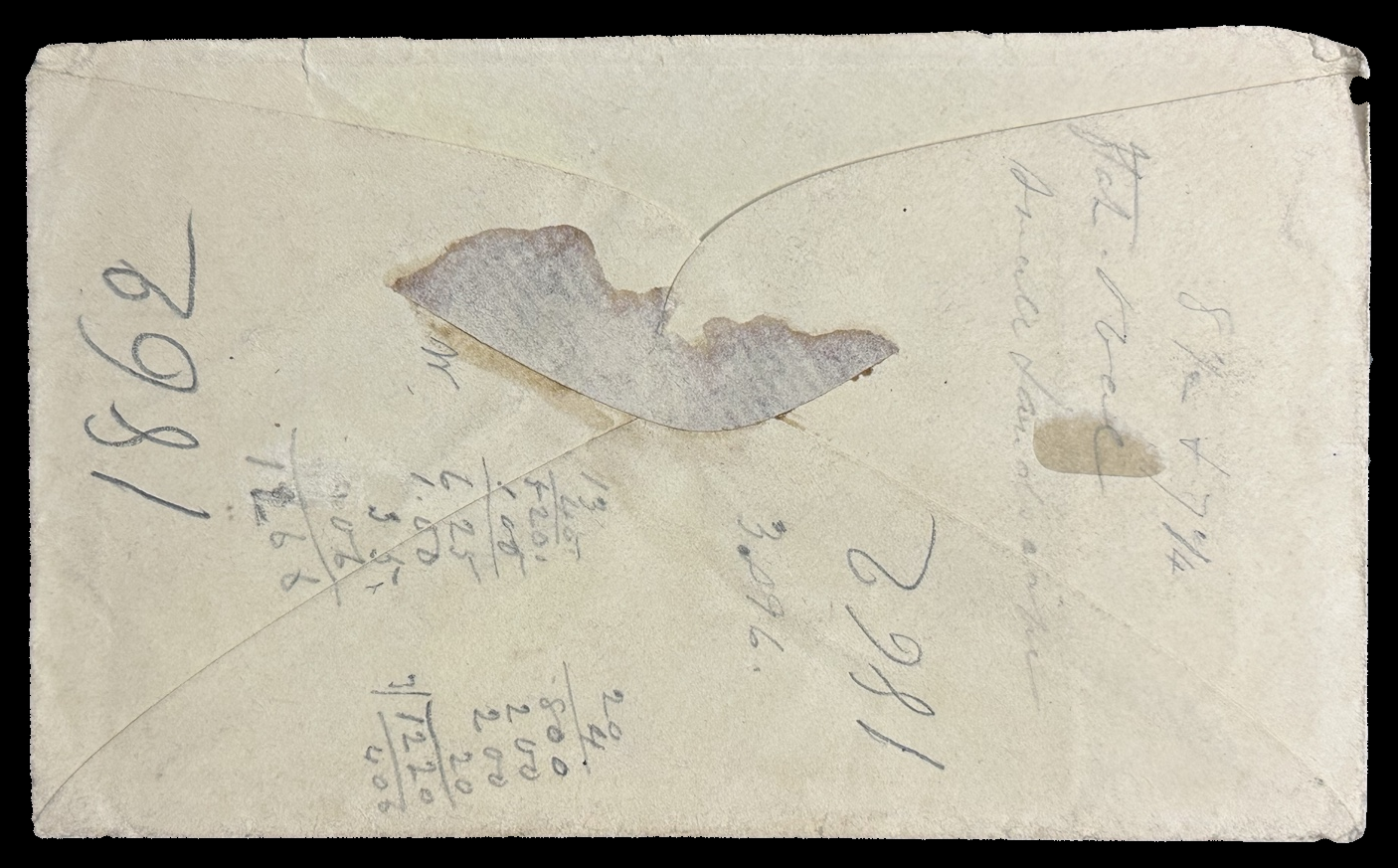
The importance of this envelope lies in the way several histories overlap on a single sheet of paper. It documents a named New York trade establishment, an address occupied by identifiable mirror craftsmen, the marketing language of the decorative-furnishings business, the postal rate of the Civil War era, and correspondence with a documented Princeton resident.
It also illustrates the limits of object-based research. The factory’s trade name and address are secure. Hoffman and Kreps are securely associated with mirror work at that address in the 1859–60 directory. Kreps’s earlier work as a gilder and later listing in the frame trade establish a meaningful occupational continuity. Alexander Gulick’s identity and civic and family background are well documented. But the factory’s legal proprietorship, the exact contents of this letter, and the precise subtype of the three-cent stamp remain unresolved.
Those uncertainties do not weaken the object. They define what it can honestly tell us. The envelope is a small surviving piece of the material culture of commerce: advertising that traveled, a business address that can be rebuilt from directories and newspapers, and a customer name that leads into the history of Princeton. It is the kind of object for which postal history becomes urban history, decorative-arts history, and family history at once.
Object file
- Object: Illustrated commercial advertising cover for the New York Looking Glass and Ornamental Frame Factory.
- Date: 1862, supported by the surviving object record and manuscript dating; exact day and month are not asserted here without a clearer direct reading of the cancellation.
- Origin: New York, New York.
- Destination: Alexander Gulick, Princeton, New Jersey.
- Business address: 434 Broome Street, a few doors east of Broadway.
- Advertised trade: Looking glasses, ornamental and picture frames, gilt and rosewood cornices, gilt tables, and related decorative furnishings.
- Associated tradesmen: John H. Hoffman and Henry Kreps, both listed in the 1859–60 New York directory as mirror dealers or workers at 434 Broome Street. Proprietorship not established.
- Postage: Three-cent Washington, 1861 issue, National Bank Note Company type; exact shade and Scott subtype not confirmed from the photograph alone.
- Rate: Three cents for a prepaid domestic letter of one-half ounce or less traveling under 3,000 miles.
- Collecting interests: U.S. postal history; Civil War-era civilian mail; New York advertising covers; looking-glass and frame makers; gilding and decorative arts; Princeton, New Jersey; Gulick family history.
Research notes and sources
This article distinguishes evidence printed or written on the original cover from information reconstructed through directories, advertisements, institutional archives, postal records, and later historical publications. The ownership structure of the factory and the subject of the enclosed letter remain unknown. The stamp is identified to the 1861 three-cent Washington issue rather than assigned a definitive shade or Scott subtype.
- New York newspaper, September 10, 1859 — advertisement for “The New York Looking Glass and Ornamental Frame Factory,” 434 Broome Street, a few doors east of Broadway.
- Trow’s New York City Directory, 1859–60, Hoffman entries — John H. Hoffman, mirrors, 434 Broome.
- Trow’s New York City Directory, 1859–60, Kreps entries — Henry Kreps, mirrors, 434 Broome.
- Doggett’s New-York City Directory, 1847–48 — Henry Kreps listed as a gilder, documenting his earlier connection to the ornamental-frame trade.
- Wilson’s Business Directory of New York City, 1874 — Henry Kreps listed in the picture-frame trade, demonstrating later occupational continuity.
- New York University Faculty Digital Archive, New York City Directories Extracted Persons Entries, 1850–1890 — machine-readable directory corpus and documentation for the Trow directories.
- New York Public Library, Perris map bounded by Broome Street, Bowery, Canal Street and Broadway, 1857–62 — period mapping of the factory’s neighborhood.
- Library of Congress, Broadway from Broome Street, looking up — period stereographic view of the Broadway and Broome Street area.
- Princeton University Library, Gulick Family Papers — archival history of the Gulick family and William Gulick’s stagecoach operations linking central New Jersey with Philadelphia and New York.
- Genealogical Record in One Line of the Gulick Family — Alexander Gulick’s birth, death, parentage, and marriage to Almira Reading.
- History of Burlington and Mercer Counties, New Jersey (1883) — Princeton civic lists including Alexander Gulick among chosen freeholders.
- Gulick’s Executors v. Gulick, New Jersey Court of Chancery (1874) — later legal record concerning William Gulick’s estate and Alexander Gulick’s role as executor.
- United States Postal Service, Rates for Domestic Letters, 1792–1863 — three-cent prepaid domestic rate under 3,000 miles in force during 1862.
- Smithsonian National Postal Museum, 1861 Issues — production, postal use, and shade complexity of the three-cent Washington.

