OldStamps.org — Object File No. 001
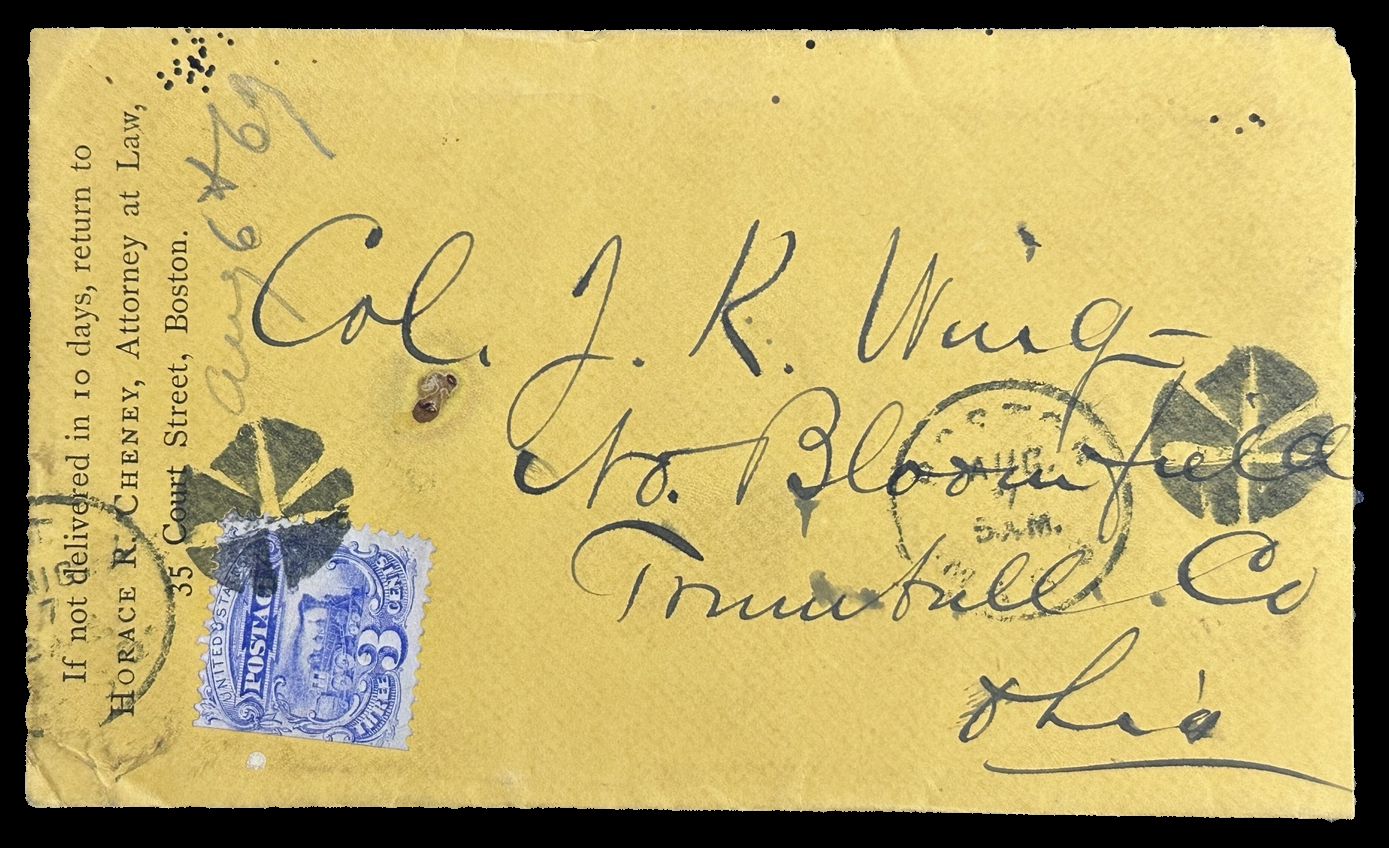
A small yellow envelope traveled from a lawyer’s office in Boston to an Ohio village in the summer of 1869. It cost three cents to send. A bright blue locomotive stamp paid the charge, and a heavy geometric cancellation ensured that the stamp could not be used again. To a postal historian, the envelope is an attractive example of the United States’ short-lived pictorial stamp series. But the addresses turn it into something else: a surviving trace of correspondence between two men newly joined by marriage, whose families stood at the intersection of the Civil War, abolitionism, education, and public service.
FROM THE TNSTAMPS COLLECTION · EBAY LISTING
Interested in this original cover?
The Horace R. Cheney 1869 Boston-to-Ohio cover examined here is connected to a TNstamps eBay listing. See the original item, detailed photographs, price, and current availability on eBay.
TNstamps is the affiliated selling business. The historical research remains available whether or not an item is still for sale.
An attorney at 35 Court Street
The printed instruction running up the left edge leaves little doubt about the origin of the envelope: “If not delivered in 10 days, return to HORACE R. CHENEY, Attorney at Law, 35 Court Street, Boston.” The recipient’s name is handwritten as “Col. J. K. Wing,” with North Bloomfield, Trumbull County, Ohio, below it. The printed return instruction represents an early, practical form of commercial stationery: it identified the sender and supplied a route home if the postal service could not complete delivery.
The Boston circular datestamp appears to read AUG 7, with a 5 A.M. time indication. A separate pencil inscription reads “Aug 6 ’69.” The month and day are visible in the postal marking, but the year is an attribution supported by the pencil note, the stamp issue, and the people involved—not a year legible in the circular datestamp itself. The safest description is therefore apparently August 7, 1869. Two bold, segmented cork-like strikes and a circular postmark occupy much of the front, overlapping the script.
A locomotive on a three-cent stamp
The adhesive is the three-cent ultramarine 1869 Pictorial Issue, Scott 114, with its miniature steam locomotive. Issued by the National Bank Note Company, this design departed from the portraits of prominent Americans that had dominated earlier United States stamps. The 1869 pictorials introduced transportation and historical imagery into everyday postal correspondence. The three-cent locomotive became the workhorse of the series because it paid the ordinary domestic letter rate for a letter weighing up to one-half ounce.
The National Postal Museum notes that the locomotive design had roots in a bank-note vignette. There is an apt historical symmetry in this particular use: while a locomotive raced across the small stamp, railroads and expanding postal routes were helping bind Boston, the Western Reserve of Ohio, and the broader postwar United States into an increasingly connected country. The cover documents a normal-rate domestic journey, not an extraordinary postal rate. It is the combination of its surviving markings, distinctive stamp, and identifiable correspondents that makes it unusually engaging.
Horace Rundlett Cheney: a promising Boston lawyer
“Horace R. Cheney” was Horace Rundlett Cheney (1844–1876), a Bowdoin College graduate who studied law at Harvard. The school newspaper, The Bowdoin Orient, remembered him as the first tutor and first librarian at Bates College after his 1863 graduation. It later reported, in June 1871, his appointment as assistant district attorney of Suffolk County, Massachusetts. A nineteenth-century Hyde Park historical account also records his association in a law practice with Charles W. Turner.
His father was Oren Burbank Cheney, the educator and abolitionist who founded what became Bates College and served as its first president. Bates College’s own archival history records Oren’s antislavery commitments, including his involvement with the Underground Railroad and his support for educational opportunities for formerly enslaved people. Horace’s early service as a Bates librarian therefore belonged to a larger family commitment to education, reform, and public life.
In August 1869, when this envelope was apparently mailed, Horace was about twenty-four years old and still near the beginning of his legal career. His promotion to an assistant district attorneyship lay nearly two years ahead. The stationery fixes him not as an established late-career figure but as a young attorney with a professional address in central Boston.
Colonel Wing of North Bloomfield
The addressee, Joseph Knowles Wing (1810–1898), had lived in North Bloomfield, Ohio, for decades. During the Civil War he served as a United States Army quartermaster officer; a family history records service on the staff of General Grenville M. Dodge, an assignment associated with the Atlanta campaign, and later duties in North Carolina. The same history records that Wing was elected to the Ohio House of Representatives in 1869 and re-elected in 1871. The honorific “Col.” on the cover thus referred to military service, while his political career was just emerging.
Wing’s wife, Mary Brown Wing, came from a family prominent in the settlement of Bloomfield. Her father, Ephraim Alexander Brown, helped develop the township in Ohio’s Western Reserve. A published family history identifies Brown as an active participant in the Underground Railroad. It is striking that the two families connected by this cover each had a close relative involved in antislavery activity: Oren B. Cheney in Maine and Ephraim Brown in Ohio. The envelope does not tell us what its sender or recipient believed on any particular issue, but it sits within two documented reform-minded family histories.
A letter to his father-in-law
The central discovery is genealogical. Colonel Wing’s daughter Virginia Passavant Wing, born in Bloomfield in 1846, married Horace Rundlett Cheney in 1869. The cover, therefore, was addressed by a newly married Boston lawyer to his father-in-law in Ohio. It might have carried family news, business, a request, or something entirely routine. No enclosed letter has been provided, so its subject cannot be recovered from the envelope.
One family genealogy gives the wedding date as June 30, 1869, in Bloomfield, while another printed genealogy records March 30, 1869. Without an original marriage register or contemporary announcement to settle the discrepancy, the date should remain unresolved. On either account, the apparent August mailing occurred within months of the wedding. The closeness of the two events invites interest; it does not license us to invent what Horace wrote.
The family history that followed
The record grows unexpectedly personal after the letter’s journey. A register of Hyde Park births, later reproduced in the Hyde Park Historical Record, lists a daughter born to Horace R. and Virginia P. Cheney on February 5, 1871. Virginia died on February 13, eight days later, at the age of twenty-four. The Riverside Cemetery register in Lewiston, Maine, then records the death of an unnamed infant daughter of Horace and Virginia on February 15, 1871. Mother and child appear together in the same family plot. The proximity of these events is certain; the medical circumstances of either death are not established by the records consulted.
Horace continued his legal work. In 1874 he married Mary Chace; the archival description of a surviving wedding invitation is held among the Chace-Tolman family papers in Rhode Island. The couple had a daughter, Elizabeth Caroline Cheney, born in 1875. An obituary notice printed by The Bowdoin Orient reports that Horace died in Philadelphia on December 13, 1876, aged thirty-two, leaving a wife and child. The Lewiston cemetery register records his burial in the same family lot as Virginia and their infant daughter.
None of those later events can be read backward into the sealed contents of this 1869 envelope. Yet the documentary sequence gives perspective to a piece of stationery that otherwise seems purely utilitarian. We can identify its two principals, their family relationship, the year of their new connection, and the life stories that followed. What we cannot identify is the news that moved between them on this particular day.
What survives
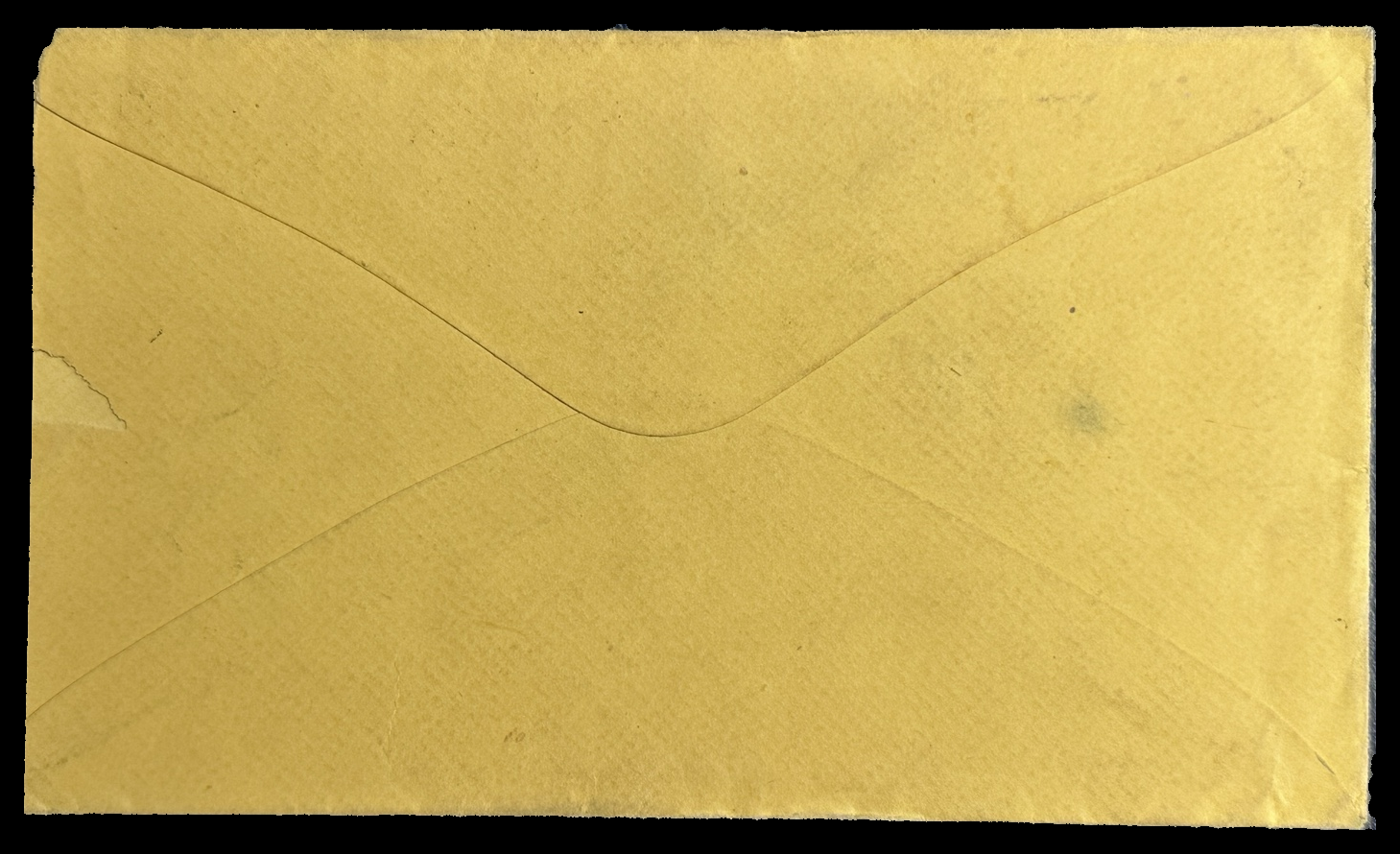
The back of the yellow envelope is comparatively plain. Its closing flap and seams survive, with age-toning, handling marks, and a small edge separation. There is no visible transit or arrival marking on the reverse. The face retains a strong mixture of printed office instructions, cursive address, black cancellation, and the blue locomotive adhesive. The images shown here retain the cover’s physical irregularities; only the original photographic background has been replaced with a clean black presentation matte.
The object illustrates what postal history can do at its best. A three-cent rate, a routine cancellation, and a few inked names are sufficient starting points for a history of a lawyer, a military officer, two connected families, and the United States in the years after the Civil War. It is not a preserved letter, and it does not speak in the voices of its correspondents. Nevertheless, the envelope remains evidence that someone in Boston sent something to Colonel Wing in Ohio—and that the ordinary machinery of the post carried it there.
Object file
Object: United States domestic letter cover with printed attorney return address; yellow envelope, front and reverse.
Apparent mailing: Boston, Massachusetts, August 7, 1869 (month/day and time indicated in postmark; year supported by separate pencil annotation and contextual evidence).
Originator on stationery: Horace R. Cheney, Attorney at Law, 35 Court Street, Boston.
Addressee: Col. J. K. Wing (Joseph Knowles Wing), North Bloomfield, Trumbull County, Ohio.
Postage: United States 1869 three-cent ultramarine Locomotive Pictorial, Scott 114; ordinary domestic letter rate up to one-half ounce.
Postal markings: Boston circular datestamp apparently AUG 6, 5 A.M.; prominent segmented geometric cork-style cancellation. Exact killer subtype not assigned.
Condition and limits: Surviving folds, edge wear, and age toning; no visible reverse backstamp. Grill, stamp subtype, and original letter contents not established from supplied images.
Collection status: View this cover on eBay — item 206678652225.
Research notes and sources
This article distinguishes inscriptions visible on the object from historical claims supported by external records. The image establishes the stationery, recipient as written, stamp, and postal marks. The precise year of mailing is not separately legible within the dated cancellation. The existence of the marriage is well attested, but the two genealogies consulted disagree on March 30 versus June 30, 1869.
The following original records, institutional finding aids, and published family histories support the account:
1. The Huntington Family in America, pp. 640–642 — Joseph Knowles Wing’s Civil War and Ohio legislative service; Virginia’s full name, June 30 marriage date, and death; Ephraim Brown and the Underground Railroad.
2. Clary and Allied Families genealogy, p. 75 — identifies Virginia F. Wing and Horace R. Cheney and provides the conflicting March 30 wedding date.
3. Bowdoin Orient, June 17, 1871 — contemporary alumni notice of Horace R. Cheney’s appointment as assistant district attorney of Suffolk County.
4. Bowdoin Orient, 1876–1877, p. 141 — Horace Rundlett Cheney’s obituary, Bowdoin and Harvard affiliations, Bates teaching and library roles, death, and survivors.
5. Bates College Archives: Oren Burbank Cheney records — institutional background on Oren B. Cheney, the founding of Bates, and his antislavery work.
6. Hyde Park Historical Record, vol. 3 — local legal reminiscences and the February 5, 1871, birth entry for Horace and Virginia Cheney’s daughter.
7. Maine cemetery transcription, Riverside Cemetery, Lewiston, lot 0361 — cemetery records for Horace, Virginia, their infant daughter, and Oren B. Cheney.
8. Chace-Tolman family papers, Rhode Island archival finding aid — an original 1874 Cheney–Chace wedding invitation and a surviving photograph of Horace Cheney are listed in the collection.
9. National Postal Museum, 3-cent Locomotive G-grill single and Pictorial Issues (1869–1870) — identification and period context for the 1869 stamp; U.S. Philatelic Classics Society, The 1869 Pictorials — postal history and use of the issue.


Leave a Reply