
OldStamps.org — Object File No. 006
A nineteenth-century advertising envelope can sometimes preserve an industrial relationship more clearly than a surviving machine. This cover, mailed from Erie, Pennsylvania, to Thomas T. Hall at Harmonsburg, carries a green three-cent stamp and a printed illustration advertising the wooden-pump business of G. R. Wood. On its face, it is an attractive piece of commercial postal history. Once the two names are researched, however, the envelope opens onto a much larger world of timber, sawmills, farm water systems, and small-scale manufacturing in northwestern Pennsylvania.
Wood can be documented in Erie as a manufacturer of wooden pumps, water pipe, and agricultural implements. Hall, at the other end of the letter, was not merely a name in a rural address. He had purchased hundreds of acres of woodland in Crawford County, helped clear it, built a steam sawmill, and operated that mill for about a decade. The contents of their correspondence are gone, and we cannot prove why Wood wrote to Hall. But the surviving envelope connects two men whose lives occupied closely related parts of the same nineteenth-century economy.
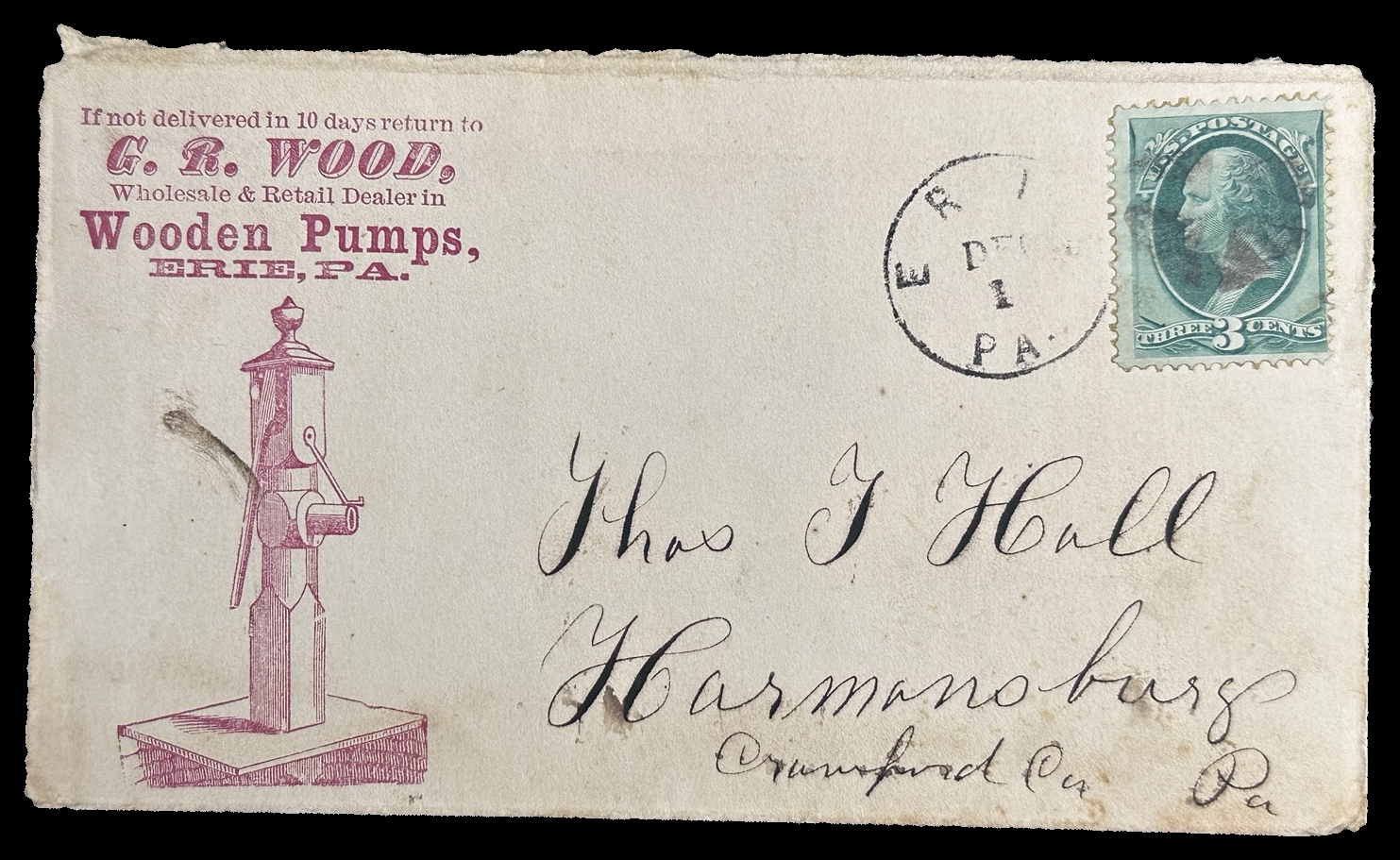
G. R. Wood at 18th and Peach Streets
The strongest surviving evidence for Wood’s business comes from Hamilton Child’s Gazetteer and Business Directory of Erie County, Pa., for 1873–4. On page 172, a display advertisement identifies G. R. Wood as a manufacturer of wooden pumps, water pipe, and agricultural implements at the corner of 18th and Peach Streets, Erie. The classified index places Wood under both “Agricultural Implements” and “Pumps, Water Pipe Etc.”
That directory matters because it was not compiled casually. Child explained that his agents traveled township roads and called at farms and places of business in an effort to collect information directly. Wood’s advertisement therefore gives us a firm contemporary anchor for the enterprise represented on the envelope: he was presenting himself publicly as a manufacturer, not simply as a hardware merchant reselling somebody else’s pumps.
Wood’s full identity remains less certain. Searches of digitized directories and other indexed material have not yet produced enough evidence to expand “G. R. Wood” into a securely documented full name. That unresolved point is worth preserving. The business is well documented; the proprietor’s complete biography is not.
Erie and the wooden-pump trade
Wood was operating in a city and county where wooden pumps were a recognizable manufacturing specialty. The same 1873–74 directory describes several competing pump works and provides unusually concrete production figures.
Marsh & Low’s Pump Works, established in 1865, employed eight men and was producing roughly 5,000 to 6,000 pumps annually. The directory reported that the works consumed about 300,000 board feet of cucumber-wood lumber. L. W. Olds’ Pump Works, founded in 1845, employed ten men and used about 250,000 feet of cucumber lumber each year. G. Olds & Co. produced about 1,000 pumps annually, with capacity for substantially more, using cucumber wood and oak.
The trade extended beyond Erie city. At Union City, Hunter’s Cucumber Wood Pump Factory employed twelve workers, while Abbey, Graser & Co.’s cucumber-wood pump and chair works employed thirty and claimed capacity for 15,000 pumps a year. These were not isolated craftsmen boring a few pump logs for neighboring farms. Wooden pumps formed part of a substantial regional wood-products economy.
A later Erie County history still remembered the Olds concern as a major local pump maker and described the broader woodenware industry as one encouraged by the region’s supply of desirable timber. By 1881 the Olds operations had been consolidated as Olds’ Pump Company. Wood’s business was therefore one participant in a manufacturing landscape in which timber, machining, cast hardware, and rural water needs intersected.
Cucumber wood—and an important caution
The repeated reference to “cucumber wood” in the period directory sounds exotic today. The name refers to the cucumbertree, Magnolia acuminata, a native North American magnolia whose wood is straight-grained and workable. The U.S. Forest Service describes it as a relatively soft, useful hardwood historically sold with or compared to yellow-poplar.
Erie’s documented pump makers clearly valued it: the directory records hundreds of thousands of board feet passing annually through competing pump works. But there is an important limit to the evidence. G. R. Wood’s own advertisement does not say what species of wood he used. The regional context makes cucumber wood relevant to the story of the trade, but it should not be assigned to Wood’s individual pumps without direct evidence.
The same directory page offers another glimpse of Erie’s supporting industrial network. Immediately below Wood’s advertisement, Selden & Griswold Manufacturing Co. advertised castings “for Wooden Pumps.” That does not prove Selden & Griswold supplied Wood, but it demonstrates that Erie manufacturers could draw on a local trade in specialized pump hardware as well as lumber and woodworking skill.
The man at Harmonsburg: Thomas T. Hall
The handwritten destination on the cover can be identified with unusual confidence. The 1885 History of Crawford County, Pennsylvania contains a biographical sketch headed “Thomas T. Hall, farmer, P. O. Harmonsburg.” The match of full name and postal address makes him the clear historical candidate for the addressee.
Hall was born in Chester County, Pennsylvania, on September 3, 1813, the son of Thomas and Phoebe Mode Hall, members of the Society of Friends. In 1848, when he was about thirty-five, he moved west to Crawford County and purchased 360 acres of woodland in the southern part of Summerhill Township. According to the county history, he was instrumental in clearing about one-third of that tract.
In 1854 he married Rosannah B. Smith, a native of neighboring Summit Township and a descendant of an early Crawford County family west of French Creek. By 1885 Hall retained fifty acres of well-improved land from his original purchase. The biography calls him a farmer, but that description captures only part of his working life.
A farmer who built a steam sawmill
The most important discovery in Hall’s biography is a short passage about lumber. Hall built a steam sawmill in Crawford County and operated it for about ten years. The mill eventually burned, causing a reported loss of $1,000—a substantial setback in the nineteenth century.
That fact changes the character of the cover. Hall had entered Crawford County by purchasing a large tract of woodland and had direct experience converting the region’s timber into a commercial product. Even if the sawmill had ceased operating by the time Wood’s letter was sent—the county history does not give the mill’s exact operating dates—Hall was a man who understood lumber, machinery, and rural enterprise.
His interests also reached beyond farming and milling. The 1885 biography says Hall studied medicine for two years, attended a course of lectures in Philadelphia, and was an extensive reader on scientific subjects. In politics he had been an old-line Whig and later supported the Anti-Monopoly movement; he was also described as an advocate of temperance. The portrait that emerges is of an intellectually curious rural landowner rather than a narrowly defined farmer.
Was Hall part of “Smith & Hall”?
One further clue is tantalizing but should remain qualified. The township history of Summit records that “Smith & Hall” operated a steam sawmill near the township’s north line. That north line bordered Summerhill Township—the very area where Thomas T. Hall had purchased his woodland. Hall’s own biography independently confirms that he built and operated a steam sawmill, and his wife was born Rosannah Smith.
The geographical and occupational overlap is striking. Nevertheless, the township history does not give the first names of the Smith & Hall partners, and Hall’s biography does not name a business partner. For that reason, OldStamps.org treats the identification as probable or possible, not proven. It is a promising line for future directory, deed, tax-roll, or newspaper research rather than a fact to be folded silently into the narrative.
Why Harmonsburg was Hall’s postal address
Hall’s land was in southern Summerhill Township, while Harmonsburg lay just across the township boundary in Summit. That is not a contradiction. Rural post-office addresses did not necessarily mirror township boundaries, and the 1885 biography itself explicitly gives Hall’s post-office address as Harmonsburg.
Harmonsburg was a small but active village serving an agricultural district. The 1885 township history placed its population at about 160. Summit Township contained farms, blacksmith shops, grist and sawmills, a steam saw-and-shingle mill, a cheese factory, and other small enterprises. The surrounding landscape had originally carried a wide variety of timber—hemlock, pine, oak, beech, sugar maple, sycamore, cherry, and other species—making lumbering a natural companion to farming during settlement and improvement.
A later Hall-family photograph archive preserved by Historic Sugartown even includes an image catalogued as “Thomas T Hall old home in Crawford County.” The photograph postdates the world of the envelope, but its survival is a rare visual link to the recipient’s household and family history.
What might Wood have wanted from Hall?
The envelope invites an obvious question that the surviving evidence cannot answer. Was Wood soliciting an order for a pump? Quoting water pipe? Selling agricultural machinery? Asking about timber? Following up on a previous transaction?
Any of those possibilities would fit some part of the known context, but none is documented by the empty cover. It would be especially tempting to turn Hall’s sawmill into a direct timber-supply relationship with Wood’s pump factory. The evidence does not permit that. We do not know what Wood used for his own pump stock, whether Hall’s sawmill was operating at the date of the letter, or whether the two men had any lumber transaction at all.
What can be said is narrower and more interesting because it is secure: an Erie manufacturer of wooden pumps, water pipe, and agricultural implements mailed an illustrated business envelope to a Crawford County farmer who had owned extensive woodland and operated a steam sawmill. Their economic worlds overlapped even though the purpose of this particular letter is lost.
The three-cent letter
The cover bears a green three-cent United States stamp and an Erie postal marking. Three cents was the ordinary domestic letter rate for a letter weighing no more than one-half ounce from July 1, 1863, through September 30, 1883. The postage is therefore entirely consistent with the period in which Wood is documented at 18th and Peach Streets.
The exact day and month in the Erie postmark are not sufficiently clear in the surviving photograph to state with confidence, and the exact printing of the three-cent Bank Note-era stamp should likewise remain qualified without closer physical examination. The safest dating is therefore circa the 1870s, anchored by Wood’s documented 1873–74 business advertisement and the postal use visible on the envelope rather than by an uncertain reading of a faint cancellation.

A small advertisement from a vanished working landscape
The pump printed on this envelope was intended to sell a practical object. A wooden pump was infrastructure: a way to bring water from a well or cistern to a farm family, livestock, workshop, or business. Yet more than a century later the advertisement does something else. It preserves a fragment of an Erie manufacturing trade built around timber, metal castings, woodworking machinery, and the enormous rural demand for water-handling equipment.
The address preserves the other half of that economy. Thomas T. Hall had arrived in Crawford County as an owner of woodland, cleared part of his tract, farmed it, and ran a steam sawmill for about a decade. Harmonsburg and the surrounding townships were dotted with the sort of mills, farms, and small shops to which a manufacturer like Wood could market pumps and agricultural equipment.
We may never know what the letter said. But the envelope is enough to place two documented lives on the same piece of paper: one at an Erie factory corner, the other in the wooded farm country south of Summerhill. That is the particular strength of commercial postal history. An advertising cover can survive after the product, factory, correspondence, and even the reasons for writing have disappeared—and still reconstruct the economic landscape through which it once traveled.
Object file
- Object: Illustrated commercial advertising cover for a wooden-pump manufacturer.
- Advertiser: G. R. Wood, Erie, Pennsylvania.
- Documented business: Manufacturer of wooden pumps, water pipe, and agricultural implements.
- Business location: Corner of 18th and Peach Streets, Erie, documented in the 1873–74 Erie County directory.
- Destination: Thomas T. Hall, Harmonsburg, Crawford County, Pennsylvania.
- Recipient: Thomas T. Hall, farmer; born September 3, 1813; settled in Crawford County in 1848; owner of woodland in southern Summerhill Township; builder and operator of a steam sawmill for about ten years.
- Date: Circa 1870s; exact postal date remains uncertain from the surviving image.
- Franking: Green three-cent U.S. stamp; exact Bank Note printing/Scott identification not assigned without physical examination.
- Rate: Three-cent domestic letter rate, consistent with the rate in force from July 1, 1863, through September 30, 1883.
- Postal marking: Erie, Pennsylvania postmark/cancellation; exact day and month not securely legible.
- Industrial context: Erie County supported multiple wooden-pump works; several competitors are documented using large quantities of cucumber wood.
- Research caution: Wood’s full name remains unresolved. His own use of cucumber wood has not been proven. Thomas T. Hall may have been the “Hall” of the Smith & Hall steam sawmill near the Summit–Summerhill boundary, but the surviving county history does not identify the partners by first name.
- Collecting interests: U.S. postal history; advertising covers; illustrated covers; Erie, Pennsylvania; Crawford County; wooden pumps; agricultural implements; lumber and sawmill history; industrial history.
Research notes and sources
This article separates evidence visible on the cover from information supplied by contemporary directories and county histories. The commercial relationship between G. R. Wood and Thomas T. Hall is not reconstructed beyond what the surviving sources support: the letter’s contents are missing, Wood’s full identity remains unresolved, and the proposed identification of Hall with the Smith & Hall sawmill is treated as an open research question.
- Hamilton Child, Gazetteer and Business Directory of Erie County, Pa., for 1873–4, Library of Congress — contemporary directory documenting G. R. Wood as manufacturer of wooden pumps, water pipe, and agricultural implements at 18th and Peach; also documents competing Erie County pump works and their use of cucumber wood.
- History of Crawford County, Pennsylvania (Warner, Beers & Co., 1885), Volume II — biographical sketch of Thomas T. Hall: Harmonsburg postal address, Chester County birth, 1848 settlement, 360-acre woodland purchase, marriage, farm, steam sawmill, and other biographical details.
- 1885 History of Summit Township, Crawford County — physical setting, Harmonsburg, local mills, and the reference to a Smith & Hall steam sawmill near the township’s north line.
- Historic Sugartown, Local Families Photograph Collection finding aid — Hall-family photographs, including an image catalogued as Thomas T. Hall’s old home in Crawford County.
- Smithsonian National Postal Museum, U.S. Domestic Letter Rates — three-cent domestic letter rate during the relevant period.
- History of Erie County, Pennsylvania (1884), manufacturing history — later account of Erie’s woodenware industry and the Olds Pump Company.
- U.S. Forest Service, “Cucumbertree” (Magnolia acuminata) — botanical and wood-property context for the cucumber wood documented in Erie pump manufacturing.
- Crawford County Historical Society Research & Archives — identifies surviving directories, newspapers, tax rolls, and other records that may eventually resolve the Smith & Hall partnership.


Leave a Reply