OldStamps.org — Object File No. 004
On December 29, 1880, at 5:30 in the evening, a large illustrated envelope entered the mail in Detroit. Its destination could hardly have contrasted more sharply with its point of origin. The sender, D. M. Ferry & Co., was becoming one of the most important seed houses in the United States and had just established an immense new warehouse in the heart of Detroit. The recipient, Peter W. Moore, received his mail at Blue Stores, Columbia County, New York—a tiny Livingston hamlet whose population the federal census counted at only forty-nine people in 1880.
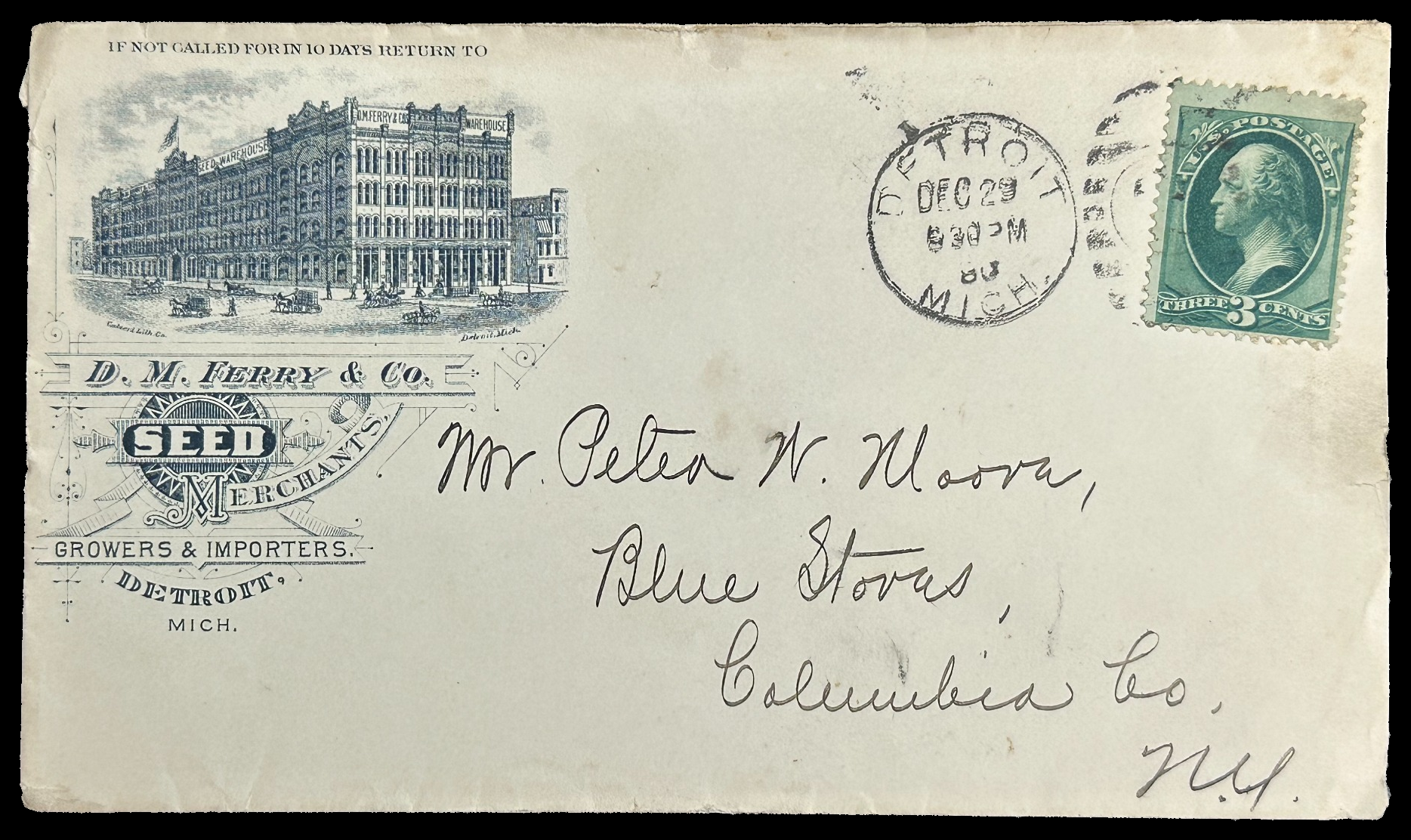
The envelope carried more than a letter. Its corner card turned the front of the cover into an advertisement for industrial scale: an engraved view of the Ferry warehouse rises above a decorative emblem identifying the firm as “Seed Merchants, Growers & Importers.” A three-cent green Washington paid the ordinary domestic letter rate. Together, the stamp, postmark, address, and elaborate commercial printing document a moment when nationally marketed consumer goods were beginning to reach even very small American communities through catalogues, local merchants, rail networks, and the U.S. mail.
A warehouse that traveled through the mail
The visual centerpiece of the envelope is the building itself. Above the company name stands a long multi-story warehouse rendered with enough architectural detail to show rows of windows, roofline signage, wagons, pedestrians, and the busy street around it. The image was not an imaginary emblem. It represented the physical scale D. M. Ferry & Co. had achieved in Detroit.
The timing is significant. The Detroit Historical Society records that D. M. Ferry & Co. was incorporated in 1879, absorbing the Detroit Seed Company with Dexter Mason Ferry as president. The New York Botanical Garden’s historical account states that Ferry’s warehouse and store were also erected in 1879. By the time this envelope was mailed at the end of 1880, the building being advertised was essentially new.
A surviving architectural rendering in the Detroit Historical Society collection provides an unusually close companion to the cover. The drawing, dated about 1880, depicts a proposed four-story D. M. Ferry seed warehouse on Brush Street between Monroe and East Lafayette Streets. It was prepared by architects George D. Mason and Zack Rice. A period photograph preserved by The Henry Ford likewise identifies the D. M. Ferry headquarters and warehouse in Detroit at about 1880.
The company was therefore using an image of its new headquarters almost immediately as a form of corporate advertising. The implication was obvious even without a written claim: this was not a neighborhood seed shop. The building itself advertised permanence, capacity, organization, and reach.
Dexter Ferry and the making of a national seed house
Dexter Mason Ferry was born in Lowville, New York, in 1833 and came to Detroit in the 1850s. According to the Detroit Historical Society, he entered the seed business in 1856 as a junior partner in M. T. Gardner & Co. Ferry bought out Gardner’s interest in 1865, and after the retirement of another partner two years later he gained control and renamed the business D. M. Ferry & Co.
Ferry’s importance lay not in inventing the commercial seed trade but in expanding and systematizing it. His company cultivated a reputation for selling fresh seed and was among the firms that helped popularize smaller packets suited to household gardens. Seeds that once might have been acquired locally, exchanged among neighbors, or bought in bulk could increasingly be purchased as standardized branded products.
The company’s growth was closely tied to printing and distribution. Seed packets, boxes, trade cards, catalogues, invoices, envelopes, posters, and dealer displays all carried the Ferry name. Surviving material in the Detroit Historical Society and The Henry Ford collections shows how aggressively the company built a recognizable visual identity around its seeds, warehouses, and annual catalogues.
The 1881 Seed Annual was arriving
The December 29 date places this mailing at an especially suggestive point in the agricultural calendar. The Henry Ford preserves a D. M. Ferry & Co. Seed Annual Descriptive Catalogue for 1881. By the opening weeks of the new year, Ferry’s catalogues were part of the seasonal machinery through which gardeners and merchants planned the coming growing season.
It would be tempting to identify the contents of this envelope as an 1881 catalogue or an accompanying business letter. That cannot be proved. No enclosure survives. What can be said is that D. M. Ferry & Co. mailed this cover on December 29, 1880, immediately before the 1881 seed season, during the same period in which its new annual catalogue was entering circulation.
The connection matters because mail was not incidental to a seed company’s business model. Catalogues created demand over long distances; correspondence transmitted orders, statements, dealer instructions, and account information; and the postal system allowed firms in major commercial centers to maintain direct relationships with people in very small communities.
From Detroit to a hamlet of forty-nine people
The address reads:
Mr. Peter W. Moore
Blue Stores
Columbia Co.
N.Y.
The locality was usually known historically as Blue Store, singular, although the envelope clearly uses “Blue Stores.” A federal geographic-names publication later specifically standardized the form as “Blue Store” and rejected “Blue Stores.”
The hamlet lay in the town of Livingston, Columbia County. A county gazetteer published in 1871–72 described Blue Store as a post-office settlement near Livingston’s western line, three miles from Johnstown and two miles from Clermont. It contained a school, a hotel, a wagon shop, a blacksmith shop, and only about half a dozen houses.
The 1880 federal census provides an even sharper measure of its scale: Blue Store had a population of forty-nine. The cover thus links a fast-growing Detroit corporation occupying a monumental urban warehouse with a postal community small enough for nearly every resident to have been personally known to the local postmaster.
That contrast is one of the most revealing aspects of the object. National distribution did not mean only selling in New York, Chicago, Boston, or Philadelphia. Businesses such as Ferry were developing systems capable of reaching the scattered rural customers, farmers, gardeners, and merchants who collectively formed a vast national market.
Who was Peter W. Moore?
The recipient is clearly written as Peter W. Moore, but his precise identity remains unresolved.
A focused search was made through publicly accessible genealogical indexes, Columbia County local histories, directory references, census-oriented resources, and material relating specifically to Livingston and Blue Store. Columbia County directories survive for 1878–79 and 1880–81, and local genealogical compilations preserve extensive material on Livingston residents. Those resources confirm the usefulness of Blue Store as a postal address, but the publicly searchable material located during this investigation did not produce a Peter W. Moore who could be securely tied to this cover.
There are nineteenth-century men elsewhere in the Northeast named Peter W. Moore, including individuals found in genealogical databases and military records. None can be connected to Blue Store by evidence strong enough to justify identification. Similarity of name is not enough.
For now, the most defensible description is therefore the simplest: Peter W. Moore was a postal patron of Blue Store, Columbia County, New York, in December 1880. Whether he was a farmer, merchant, dealer, customer, or intermediary for Ferry remains an open question. Future access to the complete 1880–81 county directory, census household images, land records, or local account books may resolve the problem.
Three cents from Detroit
The postal markings are unusually helpful. The circular datestamp reads DETROIT / DEC 29 / 5:30 PM / 80 / MICH., giving the cover a precise mailing date. The stamp is a green three-cent Washington from the Bank Note period.
Three cents was exactly the correct rate. United States Postal Service historical tables show that from July 1, 1863 until October 1, 1883, the domestic letter rate was three cents per half ounce. Distance no longer affected the charge, so the same basic rate carried this letter from Detroit to rural Columbia County.
The stamp is visually consistent with the American Bank Note Company 1879 three-cent Washington, Scott 184. The National Postal Museum records Scott 184 as a green three-cent Washington printed by American Bank Note on soft porous paper beginning in 1879. The postmark also eliminates the re-engraved blue-green Scott 207, which was not released until the summer of 1881.
There is, however, an important qualification. Earlier Continental Bank Note three-cent Washington stamps of the same general design remained valid for postage and can be difficult to distinguish from the 1879 American printing in a photograph. Paper characteristics are important to the attribution. For that reason, Scott 184 is the likely identification, but it should not be treated as absolutely confirmed without examination of the stamp itself.
The warehouse had only five years left
The building displayed so confidently on the envelope would not survive the decade.
On New Year’s Day 1886, the D. M. Ferry warehouse and its contents were destroyed by fire. The New York Botanical Garden’s history notes that the warehouse and store erected in 1879 had spanned a city block. Detroit Historical Society records also document the disaster and the death of Detroit firefighter Captain Richard Filban during the blaze.
The company recovered with remarkable speed. Ferry secured replacement seed, acquired additional businesses, operated from temporary quarters, and rebuilt. Within a few years the business was again expanding dramatically. The Detroit Historical Society records that by the early twentieth century D. M. Ferry & Co. was supplying seed to approximately 160,000 retail outlets.
That later success makes the 1880 envelope more interesting rather than less. It captures the company just after incorporation, just after construction of the warehouse, and before the catastrophic fire that forced Ferry to rebuild on an even larger scale.
Commercial architecture as advertising
The envelope also belongs to a broader history of nineteenth-century advertising covers. Instead of merely printing a return address, Ferry devoted substantial space to an architectural image. The warehouse served as a visual argument.
For a customer hundreds of miles away, the image suggested inventory, reliability, organization, and permanence. A rural recipient in New York might never see Detroit, but the envelope brought Detroit’s industrial landscape to his mailbox. Later Ferry posters, invoices, and envelopes continued to feature the company’s buildings, sometimes in increasingly elaborate scenes of warehouses, farms, box factories, wagons, and retail operations.
In that sense, the corner card did exactly what the company’s packets and catalogues did: it converted physical scale into a national brand.
What this cover can—and cannot—tell us
The evidence is strongest when it remains attached to the object.
We know the sender, the exact date and time of mailing, the destination, the postal rate, and the corporate image Ferry chose to present. Contemporary institutional collections document the warehouse represented on the envelope and the firm’s rapid expansion. Local histories establish just how small Blue Store was. Ferry’s surviving 1881 catalogue places the letter at the beginning of a new seed season.
What we do not know is the contents of the envelope or Peter W. Moore’s exact role. He may have been a customer, farmer, merchant, dealer, or simply someone corresponding with the firm. The late-December date makes seed-season business plausible, but it cannot tell us whether the missing enclosure was a catalogue, invoice, circular, statement, or ordinary letter.
That uncertainty is part of the object’s history. The cover preserves the outer machinery of a transaction even though the transaction itself has disappeared.
From a Detroit warehouse to an American garden
By the end of the nineteenth century, seed companies helped change the way Americans encountered the garden. Named varieties appeared in illustrated catalogues. Branded packets sat in local stores. Seed traveled through increasingly organized distribution networks, and customers far from the centers of production could order directly from large firms.
This envelope catches that transformation while it was still unfolding. On one side was a vast new warehouse in an industrial city. On the other was a man collecting his mail in a hamlet of forty-nine people. Between them was a three-cent stamp and a postal system capable of turning those two places into parts of the same market.
The garden, in other words, had become a mail-order business.
Object file
- Object: Illustrated D. M. Ferry & Co. seed merchants advertising cover.
- Date: December 29, 1880.
- Postmark: Detroit, Michigan; December 29; 5:30 PM; 1880.
- Sender: D. M. Ferry & Co., Seed Merchants, Growers & Importers, Detroit, Michigan.
- Recipient: Peter W. Moore.
- Destination: “Blue Stores,” Columbia County, New York; historically and officially Blue Store, town of Livingston.
- Destination population: 49 in the 1880 federal census.
- Corner card: Detailed engraved view of the D. M. Ferry & Co. warehouse and company emblem.
- Warehouse context: Ferry warehouse/store erected in 1879; architectural rendering by Mason & Rice survives from about 1880.
- Postage: Green three-cent Washington, Bank Note design; likely American Bank Note Company 1879 issue, Scott 184, but paper examination is required for definitive attribution.
- Rate: Three cents per half ounce, the domestic first-class letter rate in force from July 1, 1863 through September 30, 1883.
- Recipient identification: Peter W. Moore’s precise biography remains unresolved; no candidate located in publicly searchable records can yet be securely connected to this address.
- Collecting interests: U.S. postal history; advertising covers; seed trade; agricultural history; Detroit industry; D. M. Ferry & Co.; mail-order history; Columbia County, New York; Bank Note issues.
Research notes and sources
The identification and interpretation above separate what is directly visible on the cover from contextual evidence reconstructed through institutional collections, postal records, local histories, directories, and genealogical resources. The exact contents of the mailing and the full identity of Peter W. Moore remain unknown. The stamp attribution to Scott 184 is probable rather than certified because the 1879 American Bank Note printing is distinguished from earlier Continental printings in part by paper characteristics that cannot be established securely from the photograph.
- Detroit Historical Society, “Ferry, Dexter M.” — Ferry’s entry into the seed trade, formation and incorporation of D. M. Ferry & Co., business innovations, 1886 fire, recovery, and later national scale.
- Detroit Historical Society, architectural drawing of the D. M. Ferry & Company Seed Warehouse — circa-1880 Mason & Rice rendering of the Brush Street warehouse.
- The Henry Ford, D. M. Ferry & Company Headquarters and Warehouse, Detroit, circa 1880 — period photographic record of the headquarters and warehouse.
- The Henry Ford, D. M. Ferry & Co.’s Seed Annual Descriptive Catalogue, 1881 — surviving trade catalogue documenting the immediately following seed season.
- New York Botanical Garden, D. M. Ferry Seed Company — history of the company, 1879 warehouse, catalogue collection, 1886 fire, and rebuilding.
- Detroit Historical Society, D. M. Ferry & Co.’s Celebrated Seeds poster — circa-1882 advertisement showing the old warehouse and Calvert Lithograph Company printing.
- Detroit Historical Society, D. M. Ferry & Co. advertising envelope, 1886 — later surviving Ferry cover using warehouse imagery and demonstrating continuity of the illustrated-envelope format.
- Gazetteer and Business Directory of Columbia County, N.Y., 1871–72 — description of Blue Store as a post-office hamlet with a school, hotel, wagon shop, blacksmith shop, and about half a dozen houses.
- U.S. Census Office, 1880 population tables — Blue Store, Livingston, Columbia County, population 49.
- Columbia County civil and town history, 1786–1886 — identifies Blue Store among Livingston’s post offices in the period.
- New York Genealogical & Biographical Society, Columbia County research guide — documents surviving 1878–79 and 1880–81 Columbia County directories and Livingston research resources consulted in attempting to identify Peter W. Moore.
- Smithsonian National Postal Museum, 3-cent Washington, Scott 184 — 1879 American Bank Note Company issue, green ink on soft porous paper.
- Smithsonian National Postal Museum, Large Bank Note Issues, 1879–1881 — production history and postal use of the three-cent Washington.
- Smithsonian National Postal Museum, Re-Engraved Bank Note Issues, 1881–1882 — establishes that the blue-green re-engraved three-cent Washington was not released until summer 1881.
- United States Postal Service, Domestic Letter Rates Since 1863 — three-cent per half-ounce domestic letter rate in force on December 29, 1880.

