OldStamps.org — Object File No. 005
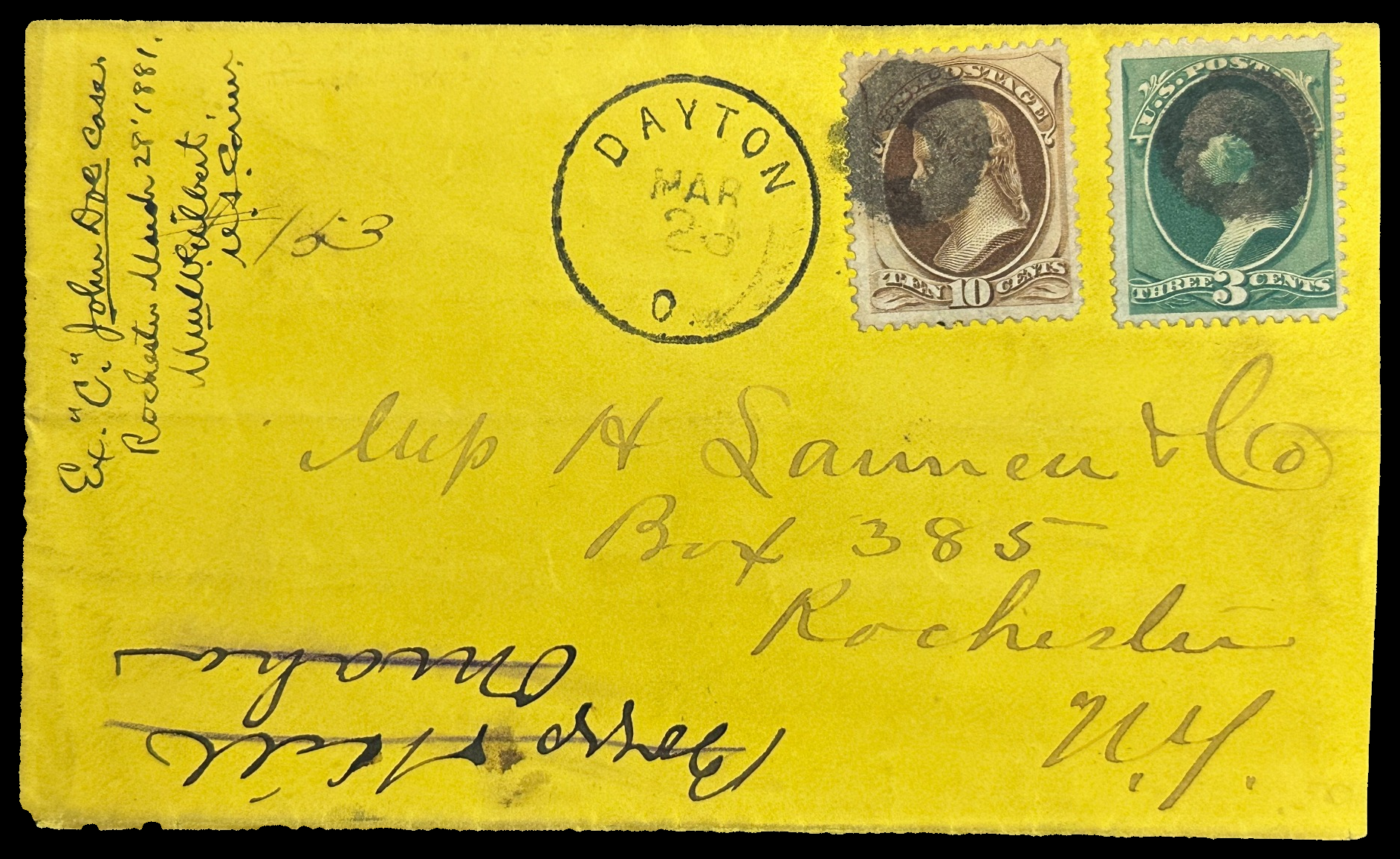
At first glance, this yellow envelope presents a straightforward postal-history question. Two Large Bank Note stamps—a brown ten-cent Jefferson and a green three-cent Washington—make an unusual thirteen-cent franking on a letter mailed from Dayton, Ohio, to Rochester, New York, in March 1881. The arithmetic turns out to be exact: three cents paid the ordinary domestic letter rate, while ten cents paid the registration fee.
Then the handwriting along the left edge changes the object completely.
Ex. “C.” John Doe case
Rochester March 28, 1881
Wm. W. Gilbert
U.S. Commr.
The envelope was no longer merely correspondence. By March 28 it had become Exhibit C in a federal “John Doe” proceeding before United States Commissioner William Wallace Gilbert in Rochester. The missing contents, the identity of “John Doe,” and the reason this particular registered letter was preserved as evidence are not stated on the surviving cover. Those gaps make the object more difficult to interpret—but also considerably more interesting.
Thirteen cents, exactly
The combination of denominations is the first strong clue to the envelope’s original postal purpose. In 1881, an ordinary domestic letter weighing no more than one-half ounce required three cents postage. Contemporary postal regulations also charged ten cents in addition to the proper postage for registration. The thirteen cents on this envelope therefore matches the registered first-class letter rate exactly.
The Smithsonian National Postal Museum likewise notes that the ten-cent Jefferson of the Large Bank Note period could be used to pay the ten-cent registered-mail fee. Registration provided additional handling and a record of mailing for correspondence considered valuable or important. Registered items were kept under controlled procedures during transit, making the service especially useful for money, legal documents, commercial papers, or other material for which the sender wanted evidence of dispatch.
No clear “REGISTERED” handstamp survives on the face of this cover. Even so, the franking is unusually persuasive evidence: the three-cent letter rate plus the ten-cent registration fee equals the thirteen cents actually paid. The safest description is therefore a thirteen-cent combination franking strongly consistent with registered domestic mail.
Dayton, apparently March 26
The Dayton circular datestamp is faint. Close examination of the surviving impression suggests March 26, although the day should be treated as a careful reading rather than an absolutely sharp strike. The year is not visible in the Dayton datestamp itself.
The federal docket supplies the year and another date: the envelope was marked in Rochester on March 28, 1881. If the Dayton reading is correct, the cover moved from Ohio to western New York in roughly two days before becoming part of Gilbert’s proceeding. That sequence is both geographically and chronologically plausible and strengthens the March 26 reading.
The Dayton cancellation: a target killer
The black postal markings on the face of the envelope perform two different jobs. The round Dayton, Ohio circular datestamp (CDS) records the place and date at which the letter entered the mails. The darker concentric-ring impressions struck across the 3-cent Washington and 10-cent Jefferson are the actual cancellations, or “killers,” intended to prevent the stamps from being reused.
The geometry of those killers is the familiar nineteenth-century target or bull’s-eye form. The safest description for this cover is therefore a black Dayton CDS with concentric-ring target killers on the two stamps. Postal historians distinguish the datestamp from the killer even when the two were applied as parts of the same cancelling operation.
It is tempting to call such markings “cork cancels,” but that would go beyond what the surviving impression proves. Nineteenth-century cancellers could be made from several materials, and the design alone does not establish the construction of the Dayton device. “Target killer” is therefore the more precise description.
Who was the Rochester addressee?
The main address is written in a light brown hand and remains partly undeciphered. The first word is most plausibly “Messrs.”, the conventional salutation for a business firm, and the line appears to end with “& Co.” The surname between them is not secure enough to identify the recipient.
Messrs. H. [surname unclear] & Co.
Box 385
Rochester
N.Y.
Several possible readings were tested against contemporary Rochester directories, including Lauren, Launen or Launer, Larmer, Lauer, Sauren, Saunen, and Saumer. None produces a convincing 1881 Rochester firm matching the address. The closest local surname is Lauer: numerous Lauers appear in the city directories, and the 1882 directory even lists Lauer Bros., but no H. Lauer & Co. appears in the 1880, 1881, or 1882 directories checked. The S-name possibilities fare no better. Sauer is an established Rochester surname, but the relevant directory pages do not produce an H. Sauer & Co. or one of the proposed Sauren/Saunen/Saumer forms.
The responsible conclusion is therefore to leave the recipient unidentified. Box 385, Rochester, N.Y. is clear enough to preserve as part of the address, but it has not been independently connected to a specific firm. The uncertainty is itself part of the object’s history: the envelope gives us a destination and the shape of a business name without yielding a documentary identification.
Exhibit C
The most consequential evidence is the docket written vertically along the left edge. It identifies the cover as Exhibit “C” in a “John Doe case” in Rochester on March 28, 1881, and is signed or certified by Wm. W. Gilbert, U.S. Commissioner.
William Wallace Gilbert is well documented. A later history of Rochester and Monroe County records that he was appointed a United States commissioner in 1869 and served in that capacity until 1898. Federal commissioners were local judicial officers who performed important preliminary functions in federal criminal matters, including examinations, warrants, bail, and the determination of whether a defendant should be held for further proceedings.
Calling the envelope “Exhibit C” implies that the physical object itself mattered to the proceeding. Its sender, address, handwriting, contents, registered status, or relationship to other evidence may have been important. The lettering also implies the existence of at least Exhibits A and B, although no related material has yet been located.
The final search for the “John Doe” case
A final research pass concentrated on federal records, Rochester material, contemporary newspaper indexing, William W. Gilbert’s known cases, Rochester city directories, and the names written on the reverse. No digitized docket, newspaper report, or published federal decision has been found that can be confidently identified as the March 28, 1881 “John Doe” proceeding.
One federal source provides useful context without solving the mystery. In March 1882, the Attorney General transmitted to Congress an Internal Revenue investigation titled Compensation of District Attorneys, Marshals, and Circuit Court Commissioners. The report includes a section headed “Before W. W. Gilbert, Com’r, Rochester” and documents a portion of Gilbert’s 1881 federal caseload. None of the printed entries can be securely matched to this March 28 envelope.
The same report makes clear that its printed list was not a complete record of every matter handled by the commissioners: additional cases were heard and parties were held to appear at later terms of court, while some later records could not be found. The surviving cover therefore cannot be assigned to a particular offense from that report. At present, the safest conclusion is simply that the envelope became evidence in a federal proceeding whose subject and parties remain unidentified.
The unexplained names on the reverse
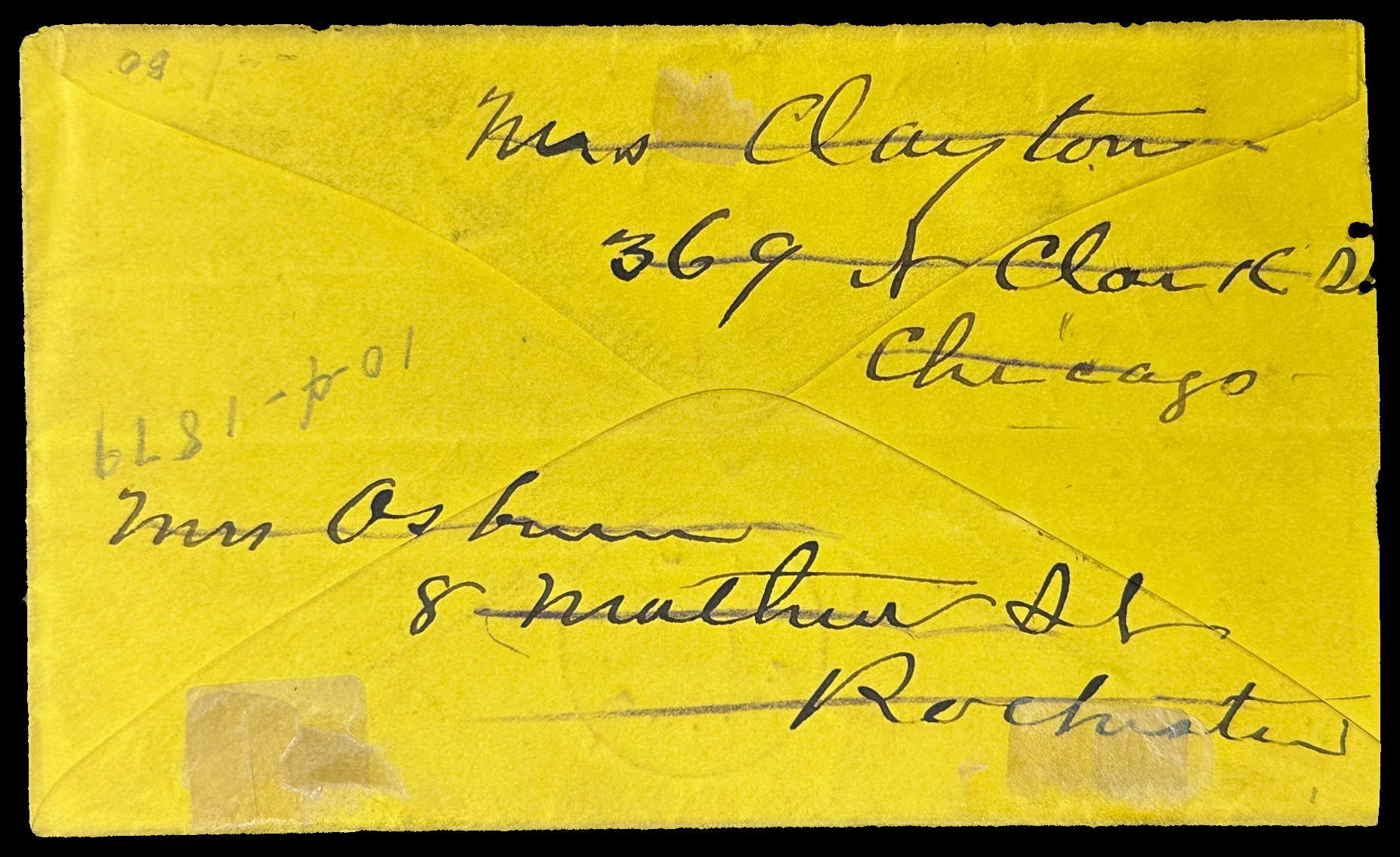
The reverse adds another layer. Two handwritten address-like notations appear to read approximately:
Mrs. Clayton
369 S. Clark St.
ChicagoMrs. Osburn [or Osborn]
8 Matthews St.
Rochester
Neither woman has been securely identified. Searches of contemporary Rochester and Chicago material have not produced a sufficiently strong match to connect either name to the federal proceeding. “Osburn” was certainly an established Rochester surname, but that fact alone is not enough to identify the person written here.
Just as important, these notations do not appear beside obvious postal forwarding or transit marks. Their relationship to the mail journey is therefore uncertain. Because the envelope later became a federal exhibit, it is possible that the names were added during an investigation or as evidentiary notes. That interpretation remains unproven.
The stamps: service matters more than catalogue number
The green three-cent Washington and brown ten-cent Jefferson belong to the Large Bank Note family of designs used through successive National, Continental, and American Bank Note printings. By 1881, American Bank Note Company issues were current, and the stamps on the cover are visually consistent with that period.
For the ten-cent Jefferson, the Smithsonian records the 1879 American Bank Note printing as Scott 188, brown on soft porous paper. The three-cent green Washington likewise has an 1879 American Bank Note counterpart. But earlier Continental printings of these designs remained valid, and specialists distinguish some of the issues by paper, secret marks, and fine design details that cannot always be resolved from a photograph.
Accordingly, exact Scott numbers should remain qualified unless the physical stamps are examined. The more important conclusion is secure without them: the two denominations total the correct amount for an ordinary three-cent letter plus the ten-cent registration fee.
Where the missing case may survive
The failure to locate the case online does not necessarily mean its records are gone. The National Archives identifies surviving nineteenth-century case files and minutes for the United States District Court for the Northern District of New York, including district-court case files beginning in 1867. Dedicated surviving records of United States commissioners described by the Archives begin later, so an 1881 proceeding may have to be reconstructed through district or circuit court files rather than a simple commissioner docket.
A future archival search would ideally combine the date March 28, 1881, William W. Gilbert’s name, the “John Doe” designation, the Box 385 Rochester address, the partially legible firm name, and any associated federal court term. Until such a record is located, the case remains genuinely unresolved.
What the cover preserves
This envelope survives at the intersection of postal and legal history. It documents a thirteen-cent postal use that fits the registered-letter rate exactly, records a journey from Dayton to Rochester, carries the docket of a long-serving United States commissioner, and—most unusually—preserves its own transformation from private correspondence into Exhibit C in a federal proceeding.
The unanswered questions matter just as much as the solved ones. We do not know the sender. The Rochester firm remains unidentified. We do not know what the registered letter contained, who “John Doe” was, what offense or dispute was being examined, or why this particular envelope became evidence.
But we can define the mystery accurately. Sometime around March 26, 1881, a specially paid letter left Dayton for Rochester. By March 28 it was in the hands of a United States commissioner and had become evidence in a federal proceeding. The paper trail then disappears—except for the envelope itself.
That is precisely why postal history can become something larger than the study of stamps and rates. A cover may be the last surviving witness to an event whose official file has not yet been found.
Object file
- Object: Domestic cover with 13-cent combination franking and later federal evidentiary docket.
- Origin: Dayton, Ohio.
- Dayton date: Datestamp appears to read March 26; strike is faint.
- Postal markings: Black Dayton, Ohio circular datestamp with concentric-ring target killers cancelling the 3-cent and 10-cent stamps; the killer material itself is not identified.
- Federal exhibit date: Rochester, March 28, 1881.
- Destination: Rochester, New York.
- Addressee: Unidentified Rochester business firm; address appears to begin “Messrs. H.” and end “& Co.,” followed by Box 385. Proposed L- and S-surname readings have not been verified in contemporary directories.
- Franking: 10-cent brown Jefferson plus 3-cent green Washington, total 13 cents.
- Rate interpretation: Exact match for 3-cent domestic letter postage plus 10-cent registration fee.
- Federal docket: “Ex. ‘C.’ John Doe case, Rochester March 28, 1881, Wm. W. Gilbert, U.S. Commr.”
- Commissioner: William Wallace Gilbert, U.S. commissioner at Rochester, 1869–1898.
- Reverse: Two unresolved handwritten address notations, apparently for Mrs. Clayton in Chicago and Mrs. Osburn/Osborn in Rochester.
- Case identification: Unresolved. No digitized federal docket, newspaper report, or published decision located that securely identifies the March 28 proceeding.
- Research caution: The recipient, the “John Doe” case, and the reason the envelope became Exhibit C remain unresolved. Directory near-matches are not treated as identifications.
- Collecting interests: U.S. postal history; registered mail; combination frankings; Large Bank Note issues; target killers; nineteenth-century cancellations; Dayton, Ohio; Rochester, New York; federal legal history; evidentiary markings.
Research notes and sources
This article distinguishes direct evidence on the cover from contextual evidence and hypotheses. The “John Doe” case and the Rochester addressee remain unidentified after searches of digitized federal records, Rochester resources, newspaper indexing, and city directories. Proposed readings of the recipient’s surname are recorded as possibilities only and are not treated as established identifications.
- Smithsonian National Postal Museum, U.S. Domestic Letter Rates — three-cent domestic letter rate in force in March 1881.
- A Store of Knowledge (1881), U.S. postal regulations — contemporary statement of three-cent letter postage and an additional ten-cent registration fee.
- Smithsonian National Postal Museum, Large Bank Note Issues, 1879–1881 — American Bank Note printings, identification characteristics, and use of the 10-cent Jefferson for registered mail.
- Smithsonian National Postal Museum, Re-Engraved Bank Note Issues, 1881–1882 — later re-engraved issues and registered-mail use of the 10-cent Jefferson.
- Smithsonian National Postal Museum, 10-cent brown Jefferson, Scott 188 — 1879 American Bank Note Company example.
- Smithsonian National Postal Museum, Marking Devices — distinguishes postmarks, which record place and date, from cancellations, whose purpose is to prevent reuse of postage stamps; also explains the development of duplex cancelling devices.
- La Posta, Vol. 21, No. 4 (September 1990) — illustrates and describes the concentric-ring “target” or “bullseye” killer and distinguishes it from the circular datestamp.
- Rochester Public Library, Rochester City Directories — relevant L- and S-name pages in the 1880, 1881, and 1882 directories were checked against the proposed recipient readings; no proposed form yielded a secure match.
- U.S. House Executive Document No. 131, 47th Congress, 1st Session (1882) — Internal Revenue investigation of 1881 Northern District of New York commissioner cases; includes a section on W. W. Gilbert at Rochester and discussion of professional informers.
- History of Rochester and Monroe County, biography of William Wallace Gilbert — records his appointment as U.S. commissioner in 1869 and service through 1898.
- Federal Judicial Center, U.S. Commissioners — historical role of federal commissioners in preliminary federal judicial proceedings.
- National Archives, Records of District Courts of the United States, Record Group 21 — surviving Northern District of New York case files and minutes relevant to a future archival search.

